Showing posts with label writers. Show all posts

Friday, September 06, 2013

PATIENCE, PERSISTENCE, AND UNWAVERING TRUST

Add to Technorati Favorites

"There is nothing impossible for him who will try!"  These are words written on a card a friend gave me when I had my wrap party to celebrate completion of my manuscript of SHADOW OF THE LION.  Of course there was more work ahead. And for the next year my mantra was "Epimoni (persistence)" and "Ipomoni - patience" .  The final editing took a good six months, and then came the months of sending out queries and playing the waiting game. But I trusted. I had Alexander on my side and he never lost a battle!  In fact, on my tack-board I had this: ALEXANDER IS THE BEACON, THE LIGHT THROUGH WHICH I SHALL ACHIEVE SUCCESS. So I have to say "Thank you, Alexander. Evharisto poli. Because you have been with me for the long years of research and writing, stopping and starting again, writing pages and pages of your story. Twenty years in all. And I never gave up. So now, it's just a matter of time until SHADOW OF THE LION will finally make its debut into the literary world. And I feel sure it will be a success.

Here's my advice to novel writers. Don't give up. Be patient, persistent and have unwavering trust that you will get the book written and it will be published.


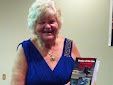
Contract signing day!
 
Meanwhile, DRAGONS IN THE SKY lies languishing on my table. I haven't done any new writing on it since before my vacation, although I did sit down the other day and sort out some time-lines.
 
This novel also has a long history. I actually began it back in the early 80's, typing on a manual typewriter as this Celtic girl, Olwen, began to tell me her story. I worked on it on-and-off, even during the time I went to live in Greece from 1983. However I got jumbled up with it, because a writer teacher I had at the time insisted I should be writing it in third person. So I kept switching back and forth and it simply didn't work. And also, some of the critiques I was getting for it from a group I belonged to were not that encouraging. So I shelved it.


 After SHADOW OF THE LION was finished and I had started pitching it to agents and publishers, I got a good bit of advice from writer Steven Pressfield. "Start working on something new."  So I took out my old manuscript of Dragons, and started to retype it into the computer. As I typed and the voice came back to me I realized that all along this was meant to be a first person narrative. It is almost like a past-life regression story and I think the roots of it were when long ago people started asking me how I knew so much about Greece and the people. (I had written an Alexander themed novel in my last year of high school). And in 1979 when I first visited Greece I had so many deja vus experiences I really began to believe I HAD been there before. Olwen's voice came loud and clear, telling me her story, how she had been brought up by the Druids, trained to be a healer and was an acolyte priestess, and after a great tragedy descended on her village was kidnapped by a renegade chieftain, taken across the Narrow Sea and across the Celtic lands as far as Macedonia where she is rescued by a young hunter (Alexander). 

When I did the time-lines yesterday I realize that I am about half done this first draft and so far whenever I workshop it my writing group (The Scribblers) loves it.  Some of the chapters are written as bardic verse, the rest in a lyrical prose style. Well, I think that just by writing this blog I have 'unstuck' myself from the writer's block that has plagued me lately. So look for most postings soon about Olwen and her adventures.

Monday, September 24, 2012

WHAT BOOKS INFLUENCE YOUR WRITING?


What books do you read while you are working a new piece of writing?  When I was writing Shadow of the Lion, I was deeply influenced by the writing of Mary Renault.  I have read all of her books going back to the very first one she published in the late '30s, but her Greek stories were what really captivated me.  I read and reread her Alexander trilogy: Fire From Heaven, The Persian Boy and Funeral Games as well as others like The Mask of Apollo and the two books she wrote about Theseus, Bull from the Sea and The King Must Die. 

After I read Funeral Games I had felt somewhat disappointed. It seemed to be documented rather than developed into the usual exciting and colorful historical fiction she had written in the other two of the trilogy. (It was the last book she wrote and she died a couple of years later). I had been fascinated by the story of Alexander since I was sixteen and read everything I could about him (mostly history books) and realized there was much more to the story than what was conveyed in Funeral Games.  So that is the reason I chose to write Shadow of the Lion, which followed the same historical period as Mary Renault's Funeral Games

I recently went back to work on the novel I'd been writing before started Shadow of the Lion.  I had spent a couple of years researching and writing Dragons In the Sky before I got discouraged with it. So I set it aside to write Shadow, first intending to write the Alexander story as a young adult book. However, after a year of working on it, I realized that it was too political a story for a young adult book, and was advised to start over, which I did, writing it in a multiple point of view. This allowed me to expand the story, develop characters and deal with the political plot to its best advantage.

Now that Shadow is finished and in the hands of an agent, I have gone back to work on the old manuscript of Dragons.  I had conceived the idea for it back in the late '70's and did some research, starting the writing in 1979.  It's a Celtic tale, taking place in the 4th century BC, Iron Age Britain, and there is an Alexander connection.  What makes this different from Shadow is that the story is almost like a past life regression. I heard this girl, Olwen, telling me her story and it is therefore written in first person with a distinctive Celtic lilt to the prose.  Some of the chapters are written in Bardic verse. Unlike Shadow which follows a historically recorded plot, this novel is purely fiction.

What books influenced me in the writing of this book?  When I started to review my old notes, I realize that a great influence on this story was Pauline Gedge's The Eagle and the Raven  and also Mary Stewart's Hollow Hills.  I'd like to reread those books again because it's been years since I first read them. They helped me get the 'flavor' and the cadence I wanted for Dragons in the Sky even though they are a slightly different time frame than Dragons. 

One thing I found when I referred so frequently to Mary Renault's books when I first started writing Shadow, was that my writing style was influenced by her writing. I began to see too many "Renaultisms" in my own writing, and had to be careful that I was not 'copying' her style. But out of this exercise I developed my own cadence and style like a student painter learns to write from the Master. I was thrilled when my late dear friend Roberto, an ardent reader, said to me "I like your style better than Mary Renault's".  That was a huge compliment!  And now I am told that Shadow is what Funeral Games should have been!  What an honour!

What books do you read that might influence your writing?  And have you found that these authors have influenced your own writing?

Monday, July 07, 2008

WHAT DO WRITERS DO BESIDES WRITING? PART 3: FUN WITH FRIENDS

CELEBRATING CANADA DAY

"A good writer possesses not only his own spirit but also the spirit of his friends." Cecily James.

It's been a few weeks of holidays and celebrating. The best parts of it were some of the times I spent with my friends. On Canada Day several of us met in the park at Granville island and spent the afternoon listening to music. It was the end of the jazz festival (I missed most of those events) and a big day of celebrating Canada's 141st Birthday. The sun was hot and the crowds all enthusiastic as they waves flags and enjoyed the day. A real show of patriotism. And a fun day for me with my friends, beginning with lunch at an Indian restaurant, then the music in the park, then a late bite to eat at our favorite jazz venue on the Drive.

Mid week my pal Andrea and I went to see an art exhibit opening at the Yaletown Gallery (www.yaletowngallery.com) The paintings were by a well-known BC poet and a good crowd showed up. My friend Jabbar is the gallery curator so we always try to go to the exhibits. It's a small gallery in a prestigious part of the city (Yaletown). Now, here's the part of this story that connects with my writing. Jabbar asked me about Shadow of the Lion. When would I finish it? Then he suggested something that certainly served as a huge inspiration. He said that perhaps when it is finished, I can do a reading at the Gallery. He would invite Iraqi and perhaps Greek artists to display. And I said, "Yes, considering you are one of the characters in the novel!"

The story is this: I have a fictional character named Nabarzanes who is a Persian court advisor from Babylon. I had written a lot about Nabarzanes and had a vision of him in my mind. But one day when I was in the L.Q. where my friends and I hang out, I saw this man and immediately I did a double take because HE was Nabarzanes. Eventually I got to be introduced to this tall, dark stranger (who I was sure was from the Middle East) and it turned out he was a refugee from Iraq, a well-known artist from Baghdad who had to flee Sadaam's regime. He and I have become good friends and that's our little 'in' joke -- that he is the embodiment of Nabarzanes.

Whether or not this 'reading' ever happens time will tell. But it was certainly a jolt of inspiration that I needed. "Hurry up and finish it!" Jabbar said. And I will!

I went out to the suburbs on Friday to spend a lovely day with my sister and catch up on family news.

So then the weekend came and it was salsa dancing time again. Every weekend 'the gang' gets together at our favorite haunt, the Latin Quarter, to enjoy the excellent Latin music of a group called Sumalao. This Friday was one of those nights full of high energy and fun.
People showed up who we haven't seen in awhile and everyone was in a merry mood. I was even given a yellow rose, a very sweet gesture from one of the Latino men. My friend Anibal used to play percussion with this group and of course there are always moments during the evening when I really miss him and start to feel nostalgic. But this was a night for being happy. It was the weekend. And life is good.
Saturday a group of friends and I met at the Heritage Grill in New Westminster to hear my son's band play. Here's Steve singing the Blues. We always like to go and support him when the band is playing. You can hear some of his music if you check his website at
www.myspace.com/stevekozakswestcoastbluesrevue

Today, Sunday, I finished tidying up my apartment and cleaning up the balcony. Then I went to buy new plants and meet my good friend Astarte for coffee. We ended up hanging out together all afternoon, bought the plants, then went to her place to drink mojitos and eat some snacks. It's been a good week, and now it's time to start some serious writing again. I'm feeling much better in mind and body.
The acupuncture has really helped my painful back/foot problem; I have managed to quieten myself and feel I am more centred once again but I still intend to keep on the regime of diet, exercise and meditation. The weather is supposed to be great all week. And even though I'll be busy teaching two night school classes a week for the month of July, I will still enjoy my outings to the beach and my social get-togethers with the wonderful group of friends I have. Yes...and for sure...I'm going to be working on the novel again. You'll see another snippet posted soon! And oh yes...tomorrow I have an interview with a prestigious writers group of retired people who need a life writing instructor. And more writing-related events are happening in the next 3 weeks.
Posted by Picasa

Wednesday, October 24, 2007

IN THE COMPANY OF WRITERS

Rainbow over Galiano Island

"For me a work of fiction exists only insofar as it affords me what I shall bluntly call aesthetic bliss."
Vladimir Nabokov 1899-1977 "On a Book Entitled 'Lolita'" 1956

Last weekend I had the great pleasure of spending three days at the Surrey International Writer's Conference (www.siwc.ca )
(Surrey is a suburb of Vancouver.) This writer's conference has won the reputation of being the best in North America and the largest in the world. People come here from everywhere to attend and there are several of the presenters who have attended year after year.
The last three years I have volunteered in order to be able to afford to spend the whole weekend there. This not only allows me a chance to meet some of the presenters personally but also to sit in on several workshops. All three years I've been given the job of introducing presenters and this is quite an honor. This year I also helped monitor the Blue Pencil Cafe where people bring some of their manuscripts in to be critiqued by the presenters. Besides the writers, there are many agents and editors at the conference and you can make appointments to see them. (15 minutes for the Blue Pencil Cafe, 10 minutes for the editor/agent appointments.)

This year I had the privilege of introducing Anne Perry, an award-winning author of Victorian mysteries from England; Bruce Hale, author of children's books, Calif. ; and Lisa Rector-Maass, editor/writer from N.Y. I also attended some excellent workshops besides these including a panel: History as a Platform for Contemporary Issues, Panel members included Diana Gabaldon, Jack Whyte, Cecilia Holland and Eric Walter (a Canadian historical writer). I also sat in on Capturing the Spirit: The Keys to Writing Biography and Memoir, and an excellent workshop presented by Cecilia Holland on Holistic Historicals: What is the Value of Historical Fiction?

This last workshop I found of particular interest and value and was able to ask a lot of crucial questions that will help me in finishing my novel. During the workshops I also learned a lot of valuable hints to help with the final edits.

I made a lot of notes and thought I'd share some of the highlights with my blog writer friends. I was so inspired and encouraged by these workshops that I came away full of new energy and knowledge that will help me immensely. So perhaps some of the tips I got will help you too!

In Anne Perry's workshop "The Butler Did It: Character Development in Fiction", she gave some tips on drawing out your characters. As yourself what are some of the negative things in a character that you find tedious and boring in a story (such as self-pity, stupidity, someone who is 'perfect', etc) And what are some positive character traits (vulnerability - to a certain extent), fear (is OK if it's real) redemption, etc) If you look at your characters and see what traits they have you can build a stronger character.
She suggested writing out the plot from the antagonist's p.o.v. to find the vulnerability in the antagonist and discover the strength and weakness of your character that will help you understand how they will overcome it. Remember the protagonist must change whle they are on their journey.

Most importantly she said "Go inside yourself. What matters to you? Your main character's strength comes from inside YOU."
Also, give secondary characters a life in your imagination but you don't have to give many details about them.
Every character has to have a life, goals achievements, etc.
And, she says if you are using multiple point of view, to use only up to five characters.

In Lisa Recto-Maass workshop "Deep Down Revision" I got some good tips to help me with my final draft. One thing she mentioned was regarding secondary characters. If you have too many who are not doing enough, whose paths don't cross, or cross only for resolution, characters who have no real purpose to further the plot, either get rid of them of amalgamate some of them into one characters. As yourself: Do they incite a plot line? If so, give them a second plot line. What is their hidden agent? (
Look for secondary motivation in everything they do.)

All the writers talked about the antagonist. What happened in their life to make them into the villain? What could come into their life to change things? What have you taken away from the protagonist to give to another character? Find conflicts: go point by point. How do your plot points connect to keep the story from being disjointed? Have a connected threat. What is your THEME? The theme is your connected thread. What if your characters had to go to a place least expected? You must go there in order to write powerful characters.
FOCUS: #1 protagonist #2 antagonist #3 plot.

In the Historical Fiction panel some interesting questions were raised and each writer on the panel had a chance to answer. As Jack Whyte said, "There is nothing new under the sun. Everything echoes in the past."
Anne Perry said: "Beliefs shift, but things in the core of us are the same. Things spring from human nature, good and evil is always much the same."
Diane Gabaldon said " History is talking about differences in people and times. To be political (politically correct) stuff isn't into the mind set of the time. Don't editorialize!"
Cecilia Holland said: "Get rid of preconceptions to get into the story and be faithful to it. Things that happen now have antecedents in the past.
Eric Walter said: "You are writing fiction and you have to get emotion in."
And three more things. "Be honest. Don't make deliberate distortions of the past. Be honest about the characters. "
"Never give up!"
"Be historically accurate but don't let history overwhelm the story."

In Cecilia Holland's workshop on historical writing, I was totally entranced. I felt an immediate connection with this writer who says she has been writing historical since she was twelve (same as me!). I asked a lot of questions which were very helpful. One was a problem I have with events (historical) that occur perhaps a year or so apart. She suggested that you can condense some time lines (and leave out dates). She also said "Don't layer in and give a history lesson. Give a sense of the values of the time."
In a question regarding historical fiction vs fantasy: "Fantasy has fantasy elements in it -- seeing the future, visions, premonitions, people doing unusual things like spitting fire"
There is also Alternative history such as: "What if the South won the Civil War?"
Using nicknames is OK. Play on words OK. For minor characters if there's names the same and you can't change or shorten, drop them.

After I got home from the conference on Sunday, my mind full of knowledge and completely inspired, I decided to email Cecilia Holland to thank her for sharing her expertise. And I was thrilled to get an immediate response thanking me and telling me to contact her if I needed 'cheering on." I was also completely surprised when Lisa Rector-Maass came over to thank me for my introduction. We talked, she asked about what I write, she said she does historicals and handed me her card. "Send it to me when you're done," she said. Wow! I was totally thrilled. Believe me, this conference is the best thing a writer could do for them self. My head is still spinning with all that I took in. And I am more encouraged and inspired than ever!

Now...back to work on my novel!

"This is a work of history in fictional form -- that is, in personal perspective, which is the only kind of history that exists." Joyce Carol Oates 1938 - Author's Note 1969.


West Coast sunset over the islands.
Posted by Picasa