Showing posts with label characters. Show all posts

Thursday, January 03, 2013

THE IMPORTANCE OF RESEARCH

Add to Technorati Favorites


Writing historical fiction can mean that a lot of time is spent doing research.  I try to limit this time for myself (because I love researching!) by making sure exactly what I want and need to find out.
There's lots of info available on-line now but it is still a good idea to visit  your library and find some of the books written on the subjects you want to know about.

Not everyone has been as lucky as I have in actually being able to visit some of the places that I am writing about. Even though some are now just archaeological ruins, you can still get the idea of the way things might have been, along with visits to the local museums and all the book research you've done. Certain things can't be 'fictionalized' and you need to be as correct as possible when describing habits, customs and locations of the places in your novels.


For my novel "Dragons in the Sky" I really lucked out when I discovered the Iron Age Celtic village at St. Fagan's Heritage Park near Cardiff Wales. Not only did I see first-hand what the houses were like people lived in back in the days I was writing about, but you could go inside the houses as well. There were people in period costume demonstrating what went on inside the houses as well as some of the materials and possessions Iron Age people would have.

I also visited the site where my story first takes place, Old Sarum on the Salisbury Plain in the south of England, and the remains of the hill fort which gave me some idea of what the terrain was like where my fictional village of Caer Gwyn was located.

But there were still lots of details I needed to know about the life of the Brythonic Celts.  So I went back to the books and spent a couple of weeks jotting down bits of trivia (eating and drinking habits, warriors customs such as the chopping off of enemy's heads and keeping them for trophies. And I had to learn as much as I could about the healing arts, potions and spells so I could add these details to the story. Now I must go back over what I previously had written and add these little tidbits of information which is going to make Olwen's story even more realistic and visual.

Although I am writing a strictly fiction account of this young Celtic priestess's abduction and journey across Europe to Macedonia, I still have to get certain facts straight. I have learned the names of all the tribes and some interesting facts about them. I figured out travel times (by horse) and was able to scope some of the terrain on the google maps. It's been an interesting journey so far. And I want to make it as realistic as possible so that the people come alive and are believable.

It bothers me sometimes when historical fiction writers just second-guess at details and don't take time to make sure that what they have written is logical or truthful. Yes, it is 'fiction', but if you are including historical facts, those details must be correct. As for your interpretation of the characters you have a lot of leeway and, as the saying goes "The historical fiction writer can take as many liberties as they wish in making it a better story".  When I wrote "Shadow of the Lion", I was writing from a historically recorded plot-line so much of the novel had to be correct. Luckily I had some Classical Scholar friends in Greece who helped me with some small details like the way sacrifices and offerings were made etc, what they wore, what they ate. And I was able to interpret my characters according to what research I had done about them. I was also fortunate to be able to visit many of the locations in my story, to study flora and fauna and the lay of the land. It helped me describe things in a very realistic way so that the reader can imagine being there.

"Dragons in the Sky" is not written from a historical plot-line but at some point in the story when Olwen meets Alexander, there are certain events that must be recorded accurately. I can fictionalize her view-point of these events, but historians would have objections if I had things happening with Alexander that were not possible. So I have returned to my big box of research notes that I have kept from "Shadow", and this has really been helpful to me in plotting out the next part of "Dragons."

Remember, when you write historical fiction, you must do the work. Otherwise you are bound to have readers who throw the book down saying 'this is all nonsense'. Make your fiction as realistic as you can get it, make the characters live and breath, laugh and cry. That's what makes a great story!


Friday, December 07, 2012

ALL ABOUT THE WRITING OF "SHADOW OF THE LION"

Add to Technorati Favorites
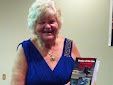
Me, at work on "Shadow of the Lion"
 
I was  recently invited to participate in a meme questionnaire about my novel "Shadow of the Lion" which is currently in the hands of an agent.  My on-line poet friend Marc Latham nominated me to join the other writers who took part in this interesting survey called The Next Best Thing. Marc writes "folding mirror poems" and you can see his interview here:

These are the questions that were asked about my novel.
What is the title of your new book?
“Shadow of the Lion”

Where did the idea for the book come from?
I have been intrigued by Alexander the Great since I was 16 and in my final year of high school wrote an Alexander themed novel. I wanted to write one just about him but Mary Renault’s trilogy covered his life. However, I was disappointed when I read her “Funeral Games” and felt there was much more to the story – mainly the story about his son, Alexander IV, the only legal heir of Alexander the Great.  I started writing a novel about the boy aimed at the young adult market but realized it was too complicated and political a story, so after a year or more of writing I began again in a multiple point of view with the theme “How blind ambition and greed brought down a world power.” That is the history I cover in “Shadow of the Lion”. The boy, who I call by his Persian name “Iskander”, is still one of the major characters in the book. But I gave a strong voice to the women — his mother, Roxana, Alexander's mother Olympias and Alexander's niece Adeia-Eurydike  as well as the generals who played a role in bringing down Alexander’s dynasty. There are only a couple of fictional characters in the novel and they are also strong characters (Nabarzanes, a Persian court advisor, an old Chaldean Magus and a young Macedonian boy, Orion, who becomes Iskander’s best friend.)

What genre does your book fall under?
Historical fiction

What actors would you choose to play the part of your characters in a movie rendition?
While workshopping it one of the movie buffs in my writer’s group kept suggestion actors to play the roles.  One would definitely be Anthony Hopkins but I’m not sure of the others. In the beginning there was a precocious little boy in the daycare where I worked who I modeled Iskander after. While I was writing it, I ran across a number of people in Greece who fit the description of the characters. I saw a waiter at a taverna on Thassos who strongly resembled Alexander and a man working in a post office in Asprovalto who was a dead-ringer for Perdikkas. Some of the actors who played in the TV series “Rome” (especially the women) would definitely fit the roles. I actually visualized the story as being played out on a big screen while I was writing it. I think it would make an excellent TV movie series such as "Rome".

Will your book be self published or published by an agency?
It is currently in the hands of a New York agent and I intend to pursue traditional publishing first as I feel the novel is worthy of a world-wide audience.

How long did it take you to write the first draft of the manuscript?
I worked by chapter segments, writing early drafts, workshopping, rewriting  all the way through the novel, which is long and dense. It literally took me about 15 years to complete and then of course there was the final reading critiques, editing by me, and finally editing by a professional editor.


What other books would you compare to within the genre?
Anything by Mary Renault, especially her trilogy on Alexander the Great. 
Steven Pressfield’s “Virtues of War”  and “The Afghan Campaign”
I was also influenced by the writing of Scott Oden (“Memnon”)  and Dr. James Dempsey (“Ariadne’s Brother”) Margaret George ("Memoirs of Cleopatra

The Lion of Amphipolis
 
Who or what inspired you to write this book?
Alexander did, of course. And the fact that I was terribly disappointed with Mary Renault’s “Funeral Games” so I wanted to write that same period of history and develop the characters and story more than she did. I lived for a number of years in Greece before and during the time I was researching for this book and had a lot of encouragement from Classical scholar friends and the Greeks themselves including the Greek Ministry of Culture and the Society of Macedonian Studies.

My Work Space
Marc suggested I invite several other writers to participate in this meme but unfortunately most of the writers I know (from the various groups I belong to) do not have blogs or websites.  You can find my website at www.ruthkozak.com and it will link you to my published travel articles, poetry publications and other published work.

Friday, November 20, 2009

SAYING GOODBYE TO FRIENDS

MY FRIEND JABBAR


As I come close to the ending of my novel, SHADOW OF THE LION, I am saying goodbye to friends (characters) who have been with me for a long time, many years in fact. So it's a nostalgic time for me. Perhaps that's why writers find it difficult writing those last few chapters, knowing that when they come to THE END they will have lost those 'friends' who have lived with them and taken over their lives, for such a long time.

It's that way with real-life friends too, who have to leave whether they leave by their own choice, or if you have had to part from them by your choice, or if for some sad reason they have departed this earth.

For about ten years now I have been friends with a very talented man, an Iraqi artist, Jabbar al Janabi. From the first moment we met I knew he was actually a character I had written into my novel, the character of Nabarzanes, the Court Advisor from Babylon. Nabarzanes is a fictional character but one I have grown to love, so when I had to exile him (rather than kill him because of Olympias' jealousy), it was a difficult goodbye. Now, my real friend Jabbar (who I always call "The Babylonian") is leaving, because of the drastic cuts to the Arts in my Province. It will be our great loss, Toronto's gain. An interesting typo on the program of his show last night said he was 'going to Toronto for god" and perhaps this was an omen of good things to come for him.

Jabbar is an exile from Baghdad (Babylon) and has lived here since the '90's, a very talented artist who was well known in his own country before he had to escape from the evil Sadaam. He always says he is Sumerian, and if you see the ancient wall carvings you will see the likeness in him -- a regal figure, gentle, kind and handsome. Every year for the past several years he has directed a show called ANU, which is symbolic of the Sumerian sun god. The performance takes place in a circle with visual artists, musicians, singers, poets and dancers spontanteously performing when the spot-light shines on them. It's a unique form of theatre. Each year it has a new theme. This year's ANU, which will be Jabbar's last (although another person is taking over for him) was "With Love from Iraq" and featured all Iraqi performers.

THE ISHTAR GATE


There was traditional music and singing, poetry and visual artists creating while the performance went on. I was delighted to see that one of the artists was actually rebuilding the famous Ishtar Gate that was a feature of Nebuchadnezzar's Babylon. The Gate is mentioned in my novel too. And there is was -- blue and gold, with the guarding lions and bulls. I was overwhelmed with emotion when I saw this, along with the haunting music and the spoken word. I was, in my imagination, transported to the Babylon I have written about, and connected with my character Nabarzanes. When I thought of him, and how I have now said goodbye to him -- a character I had become so fond of -- and how now I must say goodbye to my real friend Jabbar, I felt so sad that it was hard not to start crying.

It's difficult saying goodbye, whether it's to your written characters or the real friends you have made over the years. I am full of nostalgia and melancholy these days as I come to the end of Alexander's world. But at least my characters will still live on the pages. And I know that my friend Jabbar, The Babylonian, is going to a city where he will be accepted and successful as the truly great artist that he is. Goodbye, my friend. I will cherish all the memories that I have of our wonderful friendship. And when I get the novel published, you (Nabarzanes) will be sure to receive a copy of it because you have been such an inspiration.


Add to Technorati Favorites

Posted by Picasa

Tuesday, December 02, 2008

PROGRESS REPORT # 46: PUTTING A FACE ON THE VICTIM


THE RAGE OF ACHILLES

The first two lines of the Iliad read:

μῆνιν ἄειδε θεὰ Πηληϊάδεω Ἀχιλῆος
οὐλομένην, ἣ μυρί' Ἀχαιοῖς ἄλγε' ἔθηκεν,
Sing Goddess of the rage, of Peleus' son Achilles
the accursed rage that brought pain to thousands of the Achaeans.

Achilles is the only mortal to experience consuming rage (menis). His anger is at some times wavering, but at other times he cannot be cooled. The humanization of Achilles by the events of the war is an important theme of the narrative. (courtesy Wikipedia)

In writing fiction it's helpful to be able to impose the persona of a real person onto your character (or a composite of real characters) in order to help 'fix' them in your mind so that when you write character descriptions and action details (body language, interaction between characters etc) you have a more realistic perspective. Most of my characters in Shadow of the Lion have been 'tagged' in this way by real people I've seen or met or visualize as my characters (such as certain movie actors who would play their roles should the book be made into a movie)

I've spent lots of time while in Greece, for instance, taking down notes of people I've observed who are similar to my characters. Once I spent a lot of time and visits to the post office in Asprovalta observing a man who was identical to my character of General Perdikkas. And when I saw the tall, handsome Middle-eastern man walk into the Latin Quarter one night, I knew instantly he was my "Nabarzanes" the Persian, a fictional character in the novel. Sure enough, he wasn't Persian but from Iraq (a "Sumerian" he says) but most importantly he was actually from Baghdad which is the modern location near ancient Babylon. So, "the Babylonian" and I because good friends and my character came alive.

Lately I've been writing some violent scenes and having to dispose of some of the characters who I've grown very attached too. Whether they were particularly lovable or not doesn't matter when you have been following them around for years and writing their lives. So when the moment comes when you have to kill them off, it's a really tough call. But I found a solution of sorts. Put someone's face on them who you have had a bad experience with, then start chucking the stones or flashing the knife. You'll be able to do it with relish, trust me!

A couple of examples here: This past week there's been a serious run-in with a person who has sent extremely rude, insulting messages to me and my friends. This person has been acting the bitch for quite some time now and though we've tried mostly to ignore it, this last barrage of sheer vitriol and poison was more than we could take. Without responding in kind and lowering myself to this obviously bitter, nasty person's level, when it came to the latest "execution" that I'd been avoiding for awhile, I found it much easier to do the deed when I transposed that harpy's face onto that of my character (who, by the way, though she was also an imperious bitch had a great deal more class and grandeur and was in fact quite likeable. A tough cookie!).

I previously used the same tactics when I had to violently kill of a rather likable Athenian senator. At the time I was writing about him I met a Greek man who resembled the character exactly as I'd described him and in fact was also from Athens. I dated this guy a few times and thought he was nice, and then he showed his true colors -- a real jerk, what we'd call in Greece a "kamaki" who ended up treating me disrespectfully and rudely. How to get my revenge? Pretend it was him in the senator's place when I had to commit the murder. It worked. And I might add, it's a good way to get rid of your anger without hurting anyone or causing a scene. In both cases I was able to walk away knowing that these hurtful, mean characters no longer exist in my space and at the same put my characters to rest. I don't know if anyone else has tried this tactic. But it works!


THE TRIUMPH OF ACHILLES

Tuesday, January 01, 2008

PROGRESS REPORT 23: WEAVING THE TAPESTRY


Persian tapestry: the battle


I look at the construction of my novel "Shadow of the Lion" much as if I am weaving a tapestry. Each thread (like each word) must be placed carefully, in order to form the pattern until the picture unfolds (just as a story develops). I see each character in the story as a coloured thread woven throughout this vivid tapestry. For instance, the 'shadow' and spirit of ALEXANDER is the golden thread that weaves through the entire tapestry. His young son, Alexander IV, (ISKANDER) the titular child king who inherits his throne, is a silver thread. His Soghdian wife, ROXANA is magenta , while his mother OLYMPIAS is purple murex. PTOLEMY, who established Alexandria and the first Ptolemaic dynasty, is royal blue. KASSANDROS, Alexander's rival and eventual nemesis, is a black thread. Each of the other main characters (some who are fictional) are also 'colour coded' : NABARZANES, the Court Advisor is peacock blue, while the MAGUS is ivory. The differences between the opulent, aristocratic Persians and the rough highland warriors of Macedon prove a colorful contrast in the warp and weft of the prose. I must stand back once in awhile and look at this creation to make sure that the pattern is clear, the colours balanced, no threads are left unwoven leaving gaps in the picture. When it is finally finished, I hope it will be a masterpiece.


Tapestry reproduction of a winged bull taken from Nebuchadnezzar's palace, Babylon
You could also look at the story as a mosaic made of carefully placed tiles or, as Macedonian mosaics were, made from various colored river pebbles. Either way, the story and the words and characters that fill the story, compose a panoramic picture.

I have managed to complete another chapter and start a new one even though the Christmas season was busy and distracting. Now it is 2008 and the novel is almost done so I must stay 'at the loom', so to speak, weaving away until the last thread is tied in place.
Or, as in a mosaic, the last pebble or tile is laid.


Mosaic of Alexander battling King Darius.
Posted by Picasa

Wednesday, October 24, 2007

IN THE COMPANY OF WRITERS

Rainbow over Galiano Island

"For me a work of fiction exists only insofar as it affords me what I shall bluntly call aesthetic bliss."
Vladimir Nabokov 1899-1977 "On a Book Entitled 'Lolita'" 1956

Last weekend I had the great pleasure of spending three days at the Surrey International Writer's Conference (www.siwc.ca )
(Surrey is a suburb of Vancouver.) This writer's conference has won the reputation of being the best in North America and the largest in the world. People come here from everywhere to attend and there are several of the presenters who have attended year after year.
The last three years I have volunteered in order to be able to afford to spend the whole weekend there. This not only allows me a chance to meet some of the presenters personally but also to sit in on several workshops. All three years I've been given the job of introducing presenters and this is quite an honor. This year I also helped monitor the Blue Pencil Cafe where people bring some of their manuscripts in to be critiqued by the presenters. Besides the writers, there are many agents and editors at the conference and you can make appointments to see them. (15 minutes for the Blue Pencil Cafe, 10 minutes for the editor/agent appointments.)

This year I had the privilege of introducing Anne Perry, an award-winning author of Victorian mysteries from England; Bruce Hale, author of children's books, Calif. ; and Lisa Rector-Maass, editor/writer from N.Y. I also attended some excellent workshops besides these including a panel: History as a Platform for Contemporary Issues, Panel members included Diana Gabaldon, Jack Whyte, Cecilia Holland and Eric Walter (a Canadian historical writer). I also sat in on Capturing the Spirit: The Keys to Writing Biography and Memoir, and an excellent workshop presented by Cecilia Holland on Holistic Historicals: What is the Value of Historical Fiction?

This last workshop I found of particular interest and value and was able to ask a lot of crucial questions that will help me in finishing my novel. During the workshops I also learned a lot of valuable hints to help with the final edits.

I made a lot of notes and thought I'd share some of the highlights with my blog writer friends. I was so inspired and encouraged by these workshops that I came away full of new energy and knowledge that will help me immensely. So perhaps some of the tips I got will help you too!

In Anne Perry's workshop "The Butler Did It: Character Development in Fiction", she gave some tips on drawing out your characters. As yourself what are some of the negative things in a character that you find tedious and boring in a story (such as self-pity, stupidity, someone who is 'perfect', etc) And what are some positive character traits (vulnerability - to a certain extent), fear (is OK if it's real) redemption, etc) If you look at your characters and see what traits they have you can build a stronger character.
She suggested writing out the plot from the antagonist's p.o.v. to find the vulnerability in the antagonist and discover the strength and weakness of your character that will help you understand how they will overcome it. Remember the protagonist must change whle they are on their journey.

Most importantly she said "Go inside yourself. What matters to you? Your main character's strength comes from inside YOU."
Also, give secondary characters a life in your imagination but you don't have to give many details about them.
Every character has to have a life, goals achievements, etc.
And, she says if you are using multiple point of view, to use only up to five characters.

In Lisa Recto-Maass workshop "Deep Down Revision" I got some good tips to help me with my final draft. One thing she mentioned was regarding secondary characters. If you have too many who are not doing enough, whose paths don't cross, or cross only for resolution, characters who have no real purpose to further the plot, either get rid of them of amalgamate some of them into one characters. As yourself: Do they incite a plot line? If so, give them a second plot line. What is their hidden agent? (
Look for secondary motivation in everything they do.)

All the writers talked about the antagonist. What happened in their life to make them into the villain? What could come into their life to change things? What have you taken away from the protagonist to give to another character? Find conflicts: go point by point. How do your plot points connect to keep the story from being disjointed? Have a connected threat. What is your THEME? The theme is your connected thread. What if your characters had to go to a place least expected? You must go there in order to write powerful characters.
FOCUS: #1 protagonist #2 antagonist #3 plot.

In the Historical Fiction panel some interesting questions were raised and each writer on the panel had a chance to answer. As Jack Whyte said, "There is nothing new under the sun. Everything echoes in the past."
Anne Perry said: "Beliefs shift, but things in the core of us are the same. Things spring from human nature, good and evil is always much the same."
Diane Gabaldon said " History is talking about differences in people and times. To be political (politically correct) stuff isn't into the mind set of the time. Don't editorialize!"
Cecilia Holland said: "Get rid of preconceptions to get into the story and be faithful to it. Things that happen now have antecedents in the past.
Eric Walter said: "You are writing fiction and you have to get emotion in."
And three more things. "Be honest. Don't make deliberate distortions of the past. Be honest about the characters. "
"Never give up!"
"Be historically accurate but don't let history overwhelm the story."

In Cecilia Holland's workshop on historical writing, I was totally entranced. I felt an immediate connection with this writer who says she has been writing historical since she was twelve (same as me!). I asked a lot of questions which were very helpful. One was a problem I have with events (historical) that occur perhaps a year or so apart. She suggested that you can condense some time lines (and leave out dates). She also said "Don't layer in and give a history lesson. Give a sense of the values of the time."
In a question regarding historical fiction vs fantasy: "Fantasy has fantasy elements in it -- seeing the future, visions, premonitions, people doing unusual things like spitting fire"
There is also Alternative history such as: "What if the South won the Civil War?"
Using nicknames is OK. Play on words OK. For minor characters if there's names the same and you can't change or shorten, drop them.

After I got home from the conference on Sunday, my mind full of knowledge and completely inspired, I decided to email Cecilia Holland to thank her for sharing her expertise. And I was thrilled to get an immediate response thanking me and telling me to contact her if I needed 'cheering on." I was also completely surprised when Lisa Rector-Maass came over to thank me for my introduction. We talked, she asked about what I write, she said she does historicals and handed me her card. "Send it to me when you're done," she said. Wow! I was totally thrilled. Believe me, this conference is the best thing a writer could do for them self. My head is still spinning with all that I took in. And I am more encouraged and inspired than ever!

Now...back to work on my novel!

"This is a work of history in fictional form -- that is, in personal perspective, which is the only kind of history that exists." Joyce Carol Oates 1938 - Author's Note 1969.


West Coast sunset over the islands.
Posted by Picasa