Showing posts with label travel writing; media; night school; historical novels and ROME. Show all posts

Thursday, July 28, 2016

THE BUSY LIFE OF A WRITER


Reading at the Canadian Institute, Athens,  Oct. 2015


It's been months since I wrote in LIVING THE WRITER'S LIFE.  And yes, it's a very busy life!

First of all, no sooner had Christmas and New Years passed when I was told I'd have to move from the suite I'd occupied for 10 years.  This in itself was a trauma but when I started to look for a new place it was even more nerve-wracking and depressing.  There is a crucial  housing and suite shortage in Vancouver and it's all due to off-shore buyers snapping up houses and paying exhorbitant prices which locals could not afford.  And everyone has gotten so greedy. Imagine asking $1200 for a basement suite!  So for someone living on a pension and considered 'low income' it was a very stressful time. At first I thought perhaps I should put my stuff in storage and go back to Greece but I knew I'd have to soon start edits on Volume 2 of SHADOW so the timing wasn't right.  I thought I'd end  up in a shelter, then a travel writer friend intervened for me and I was shown a suite near where I had been living and I got it.  I moved in the beginning of April but it took a good while to get used to the new place and especially all the traffic noise. But I have adapted and feeling more 'at home' now.
Finally I am able to get back to some more writing, although I have been working on the Greek Island's ebook guide and have completed the Saronic and Ionian Islands part.
Visiting the Cave of Eurypides on Salamina island

Last week I also started the final proof edits for SHADOW OF THE LION: THE FIELDS OF HADES and it is due to be published in October. If' you've read Volume One BLOOD ON THE MOON I know you must be anxious to get this second part of the book. And I can assure you it is one that will keep you turning the pages!

 The Temple of Poseidon
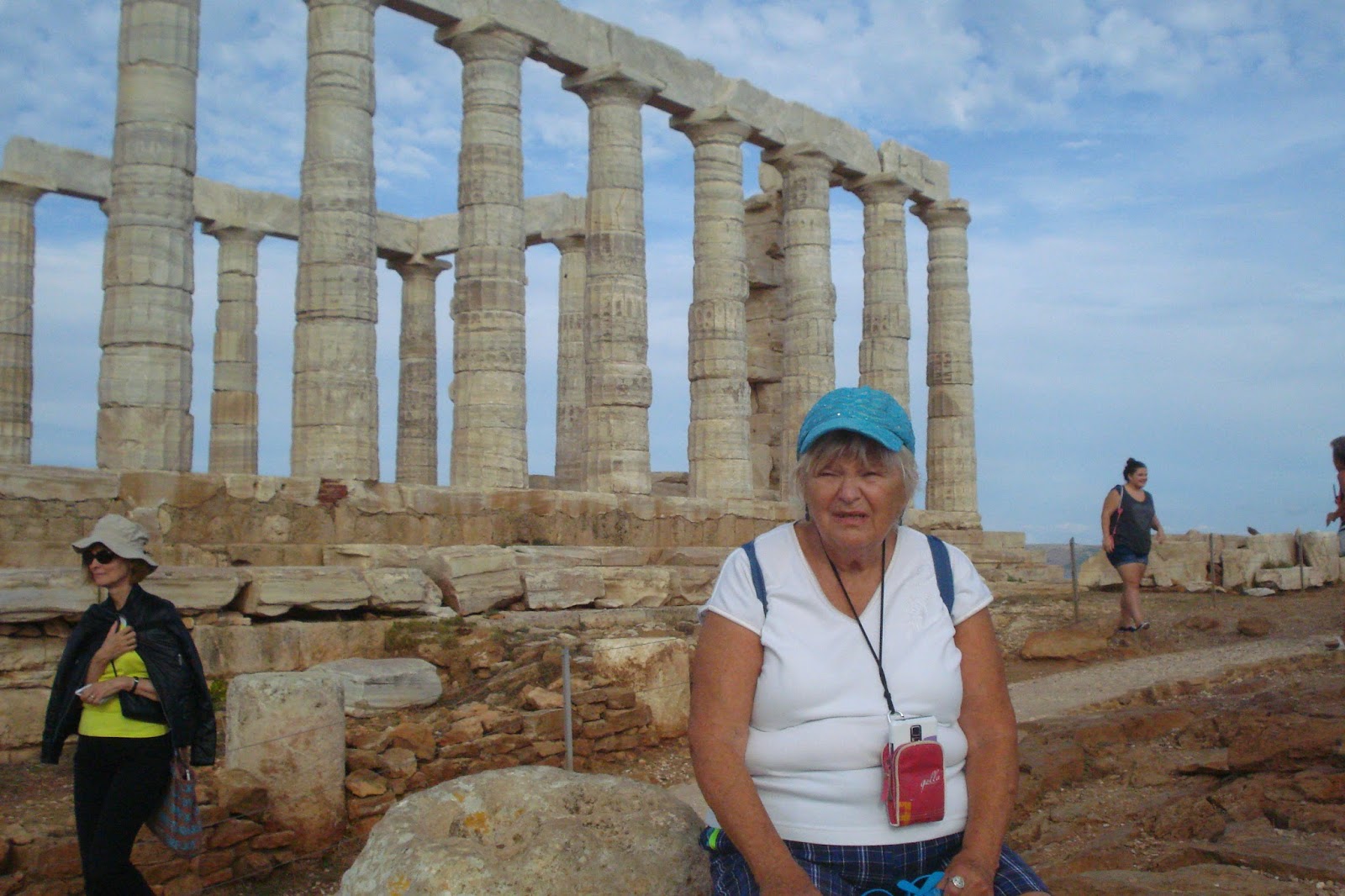
I got some inspiration from Lord Byron when I was visiting Cape Sounion
 
Meanwhile, I am planning a trip to the Islands, starting with Corfu. Flying to London first, on September 4, and visiting briefly with cousins in Caerphilly, Wales, then on to Corfu and a bit of Ionian island hoping until I reach Athens. Then later I hope to visit Crete and a few other islands including my favorite island, Naxos.
 Temple of Apollo, Naxos.

 Naxos Sunset

It's nice to be back in blog writing mode and I hope you'll see more of me in the future. 


Wednesday, October 17, 2012

PLOTTING FICTION: Where to Next?

An Iron Age Celtic Village  (St. Fagans Heritage Park, Cardiff, Wales)


When I started writing Dragons in the Sky back in the early '80's, I had a pretty good idea of how the story began. It started with me hearing the voice of the girl, Olwen, telling me her story, as if I was channeling Olwen. She is a young Celtic girl, raised by the Druids to become  priestess and medicine woman. The first chapters of the story came easily as I wrote down Olwen's words, sometimes using Bardic verse instead of regular prose chapters. She lives in a village called Caer Gwyn, much like the one in the above photo, located below a hill fort at the site of what is now called Old Sarum, on the Salisbury Plain. I've made a number of trips there to research and conjure Olwen's spirit.


Something dreadful happens at the Midsummer when Olwen is soon to be sent to the Holy Isle for her initiation.  The ricon's (tribal chieftain) renegade son, Sholto, has arrived at Caer Gwyn with a woman, the wife of another chieftain and a young boy he has taken as hostage from a rival tribe.  At the Midsummer Ceremony at the Great Stones, the angry warriors of the opposing tribes attack Caer Gwyn.  In the chaos that ensues when the village is set on fire, Olwen runs to the woods to hide and witnesses Sholto killing his younger brother Ned. He takes her as a hostage and heads south to the Narrow Sea where they take a boat across the Channel to the lands of the Belgae tribes. Olwen tries to alert the ship's boy that she is being held captive, and he tries to help her escape, but Sholto kills him.


They head off toward the east on horseback, crossing the lands of various other Celtic tribes until they reach the Alps, the country inhabited by the Helvettis, and continue on their journey.


As they proceed they meet a young warrior/hunter who tells Sholto that a king to the south is recruiting warriors for his army. This interests Sholto so he heads south, keeping a close eye on Olwen as she is his 'luck piece' because nobody dares to harm a Druid.  I know what happens once they reach Illyria, but it was the in-between part of the journey that has puzzled me.  So I have taken time to write out a rough plot of the possible things that might happen along the way, including several more escape attempts by Olwen.


I've decided to put some of it into Bardic verse rather than describe things step-by-step. The story, as told by Olwen, is written in a poetic cadence. One thing I've decided is that, having been held a captive for so long (it would take them a couple of months to cover the territory), she likely developed what is known now as "the Stockholm syndrome" where a captive becomes somehow 'attached' to their captor.  I also can see her using magic and her skills with herbs and medicines, to help her survive the arduous and sometimes frightening journey. But it was Sholto that was causing me some concern. Although the story is in Olwen's voice, I still need to make it clear what his intention are, what is he hoping to achieve on this journey?  Hopefully I have that taken care of now with my ideas for the plot outline.  It has been quite a different writing journey for me after spending all that time writing Shadow of the Lion which was based on a historic plot.  Writing pure fiction is quite a lot trickier!

Celtic Warriors


Sunday, June 17, 2012

SOMETIMES IT SEEMS NEVER-ENDING!

Me, at my work station


Sometimes it seems the work of putting a novel together is never ending!  I've been working nearly non-stop on the SHADOW OF THE LION project for literally years. I finished the book in December 2010.  Spent all of 2011 editing with two reader's critiques.  And this year, so far, more editing (professionally done). I still have to go through it one more time just to double-check spelling etc.  

There's way more to do than the actual writing and editing of a novel.  So far, I've compiled the glossary, cast of characters, Author's Note, Acknowledgements, short synopsis, and my map designer says he's almost done.  But I am still working on the long synopsis.  I've spent many hours on it so far and it isn't quite right yet.  And the synopsis has to be as near perfect as you can get it because it's part of your sales pitch.  Then there's the query letter, although I'm not too stressed about that. 

I'm aiming to get it all off and sent out into the publishing world by the end of the month.  After all these years and hours of work I am more than happy to send it on its way.  I know SHADOW OF THE LION is an excellent novel and it's my best writing.  I put my heart into it — actually my soul!

So you novice novel writers out there — especially you historical fiction writers — don't get the idea you can whip off a novel in a few months.  If you want real quality you need to do the work and spend the time.  Blood, sweat and tears, baby!  That's the way it is.  And in the end, if you are lucky, somebody might publish it! 

Thursday, January 31, 2008

PROGRESS REPORT #27: A BIT OF HISTORY

The Vancouver Public Library

Last Friday I went on a little field trip downtown. At the Vancouver Public Library there was a small exhibit presented by the Biblical Museum of Canada www.biblicalmuseum.com
The display included some interesting accurate facsimiles of historical artefacts of cultures and civilizations that provoke memory and inspire vision. This display included artifacts from the 5000 year Glory of Egypt and the Ancient World. There were a number of interesting objects from Egypt, and some Sumerian images (early Hebrew). The Golden Age of Egypt was represented by Pharaoh Amenhotep IV and his beautiful wife Nefertiti.

In one case there were articles referring to the Exodus including various papyrii. Then there was a case devoted to the downfall of Egypt begining with the Persian invasion, the the Greeks, under Alexander the Great. I was thrilled to see a (replica) of the beautiful bust of Alexander that I have seen in the Pella Museum in Northern Greece. In this bust he is about 18 years old and it was likely sculpted after the Battle of Chaironea. Following the Ptolelemaci Dynast, came the Romans. There was a copy of the Rosetta Stone and some Roman artifacts as well including a bust of Julius Caesar. (Here I should add, that our library is built to resemble the coliseum of Rome.)

Bust of Alexander from the Pella Museum
I found the diplay, though modest, inspiring and interesting. Seeing Alexander there was a huge surprise and that, if anything, made my day!

I also enjoyed the little tidbits from ancient Sumeria and Mesopotamia and it reminded me of the early part of my novel which takes place in Babylon, and all the research I did about that ancient city of Nebuchadnezzar. So I thought I'd post a snippet from the early part of my novel Shadow of the Lion (It's from Chapter Two and is in the point of view of one of my fictional characters, Nabarzanes, the Persian Court Advisor.) So, enjoy a little visit to Babylon.

NABARZANES
From outside the north gates of the palace a throng had been gathering since before dawn. The cries of jubilation at the news of the royal birth spread down the bustling Processional Way into the narrow streets of the suburbs. From the rooftops of the tall, three-storied houses, trumpets and voices proclaimed the arrival of the imperial child.

Above the glowing temples, thin plumes of smoke rose into the still air as one by one fire altars were rekindled. Pennants and garlands appeared on the city walls where adornments had been removed after Alexander’s death. The Processional Way blazed with colour and on the palace battlements the purple and gold pennants of the Shahanshah fluttered from their gilded standards.

Nabarzanes left the palace by the eastern court, avoiding the press of the crowds who waited near the main gates. He was weary from his long day in the palace. He had tarried there long after the Annointments Rites, waiting until the Magus came from the Shahryar’s bedchamber. The old man had seemed transfixed and looked as though the blood had been drained out of him. He mumbled something about a dream -- a serpent -- (had he interpreted it to be the infant Prince’s daimon?) He had said that the newborn son of Alexander needed their allegiance, and complained that the Macedonians did not see their Shah as the Hand of God. Now that Alexander was gone, there was little respect for order. It was men like he, Nabarzanes, the Magus had said, who must be loyal, as the imperial child would be dependant on those who followed the Good Religion and believed in the Truth.

Nabarzanes pushed his way through the crowds on the Processional Way, past the parade of lions adorning the high brick walls. Outside of the Temple of Ishtar with its gleaming blue-tiled steps and Ishtar’s guarding lions, hawkers were selling votive offerings and trinkets to commemorate the royal birth. Farther along, in the courtyard of the little Temple of Nabusha-hare, the temple concubines plied their trade in honour of their goddess, dancing to the music of timbrels and flutes under the orange trees. A group of richly clad men stood by laughing. One of the girls beckoned to Nabarzanes as he passed. Another day he might have stopped.

The sun, setting in a crimson blaze over the western walls of the city, reflected from the temple’s silver ornaments and red glazed bricks. Through the palms, the river shone like polished brass. A fleet of little straw-hulled boats drifted downstream toward the harbour. The coarse voices of the boatmen echoed clearly across the breadth of the river.

As he turned into the palm grove he could hear the chanting of the magi from the fire temple on the ziggurat's top tier. A long line of supplicants wound like a coloured streamer up the whorl of steps to Marduk’s shrine. The sacred fire would be ablaze on the altar. At the entrance gates, the money-lenders were doing a brisk trade.

A hand tugged at the hem of his tunic. He looked down to see a wizened face imploring him. Days of celebration were profitable for beggars too. He tossed a shekel toward the bundle of rags.

“A thousand thanks, good sire,” a cracked old voice said. “May your sons have many sons.”

The words, meant as a compliment, cut through him instead. He remembered a stormy day in Ekbatana, the birth of another child. He had tried to put it out of mind until today -- the long cold winter he had spent with Darius’s army waiting in the sanctuary fo the mountain palace after the king’s cowardly flight from the Macedonian troops. He still felt an ache in his heart when he thought of it.

That winter had taken its toll. Freezing and hungry, snowed in and trapped in the mountain palace, his wife had died in childbirth; his newborn son lived only for a day. Today, seeing the Soghdian’s infant had brought it all back to him.

He turned toward the marketplace. As far as the eye could see where tents and pavilions, astonishing colours, sounds, smells. Bright banners marked the start or terminus of this or that caravan. There were merchants here from every part of earth; jugglers, acrobat, soothsayers and snake charmers.

A parade of horsemen approached. He recognized their standards: the golden starburst on a deep blue field, the royal emblem of Macedon. He stood aside to let them pass.

General Meleager glowered down at him sullenly. Nabarzanes recollected seeing that same expression of hatefulness on the man’s face when he was viewing the Soghdian’s newborn. He saluted, but was not acknowledged. Meleager had long made known his dislike of Persians. Several henchmen rode beside him, their horses bedizoned with silver trappings and scarlet ribbons. In their midst was Philip Arridaios, dressed in Alexander’s state robe, a sleeveless chlamys made of fine wool, dyed with rich Tyrian murex, clasped at the shoulder with golden lion masks. Alexander always wore it on parade days, its rich purple-red colour distinguishing him as the King. Arridaios, wearing full parade armour under the cape, sweated in the sultry evening heat. There was a look of dull uncertainty in his eyes and he glanced around nervously as his horse approached the crowded by-way.

Nabarzanes made a gesture of prostration out of deference to royalty. One of the escort soldiers proclaimed: “Make way for Philip Arridaios, King of Macedon!”
The soldiers began to cheer. Arridaios brightened and clapped his hands. Some men came running from the street to greet the cavalcade. They were Greeks, by their dress.

“Long live Philip Arridaios!” they cried.

Meleager looked around, beaming triumphantly. “Behold! Our new king!” he shouted.

Nabarzanes watched uneasily as the troop passed. He smelled treason. He knew it from his days with Darius, when the Persian army was on the run from the Macedonians. That winter in Ekbatana, he had known that Darius would die because of it, and he was unable to protect him. He wondered if he would be able to protect Alexander’s son. For as surely as Darius’s own generals had turned against their Shah, these Macedonian soldiers were conspiring to rid themselves of Alexander’s newborn heir.

He turned into the King’s Paradise, isolated from the jubilant cries . Nabarzanes kept to his solitary walk and entered the park, away from the bustling avenue. It was quiet in the park, the street sounds were muted and ring doves cooed from the trees. He wandered through the grove, under the tall sycamores and poplars, the grass soft under his slippered feet. The exquisite perfume of jasmine permeated the evening air, mingling with the fragrance of roses from the gardens. Near the river he passed the grand mansion of the Grand Vizier Perdikkas, and could hear the sounds of revelry. The Macedonians like a good feast. This one, to celebrate the royal birth, would far surpass any other they had had in recent days. Whether they accepted the child or now, it was as good an excuse as any for a banquet.

Over the music of kitharas and flutes, he could hear their voices raised in a raucous drinking song. Judging from the sound of the merriment, it was a large feast, perhaps fifty couches. There would be dancing girls and tables heaped with food. He could smell the drift of roasting lamb.He had not been invited, a slight he had long ago grown accustomed to. When Alexander lived, Persian noblemen were always included in his banquet and state affairs. But since he had become Grand Vizier, Perdikkas had tried to please the faction who opposed Persian supremacy and only addressed him in the role of Court Advisor. Revelry was left to the Macedonians.

Being a modest and temperate man, Nabarzanes felt no ill will at being snubbed. Persian modesty greatly amused the Greeks who were happiest when they were watching naked youths play games. Persian often drank large amounts of wine on ceremonial occasions, but Nabarzanes considered Macedonian manners boorish and uncouth. He abhorred the violence that erupted each time these high-spirited mountain warriors sat round banquet table.They were always borne along on a wave of sentiment. This celebration would undoubtedly go on for days, until the wine took hold of reason and blood was spilled. Even Alexander had been known to draw his sword on occasions. Once, at Marakanda, ihe had thrown a sarissa at a friend in a fit of rage. The killing of Black Kleitos had tempered Alexander. He nearly killed himself with grief over it. After that he was more careful to water his wine.

Nabarzanes passed by the torch-lit gate house. Cries of celebration spilled out into the courtyard: high-pitched voices, laughter, the squeals of women. Macedonians were men of vulgar morals. A Persian would die of shame rather than expose his woman to debauchery. He thought their behavior disgraceful. The first time he heard them address their king by his name “Alexander”, as familiarly as a common foot-soldier to his drinking mate, he was mortified. He had been raised in the court at Susa, sent there when he was five years old, the only son of a wealthy Median nobleman, cousin of the old Shah Ochus. He had been raised with royal children, educated in court affairs, poetry and the sciences, and taught to honour the Good Religion. By right of birth he chose to join the distinguished hazarapats, the Immortal Ten Thousand Bodyguards who carry golden pomegranates on their spear butts, and march beside the Shah in battle. He learned to humble himself before the Shah, and would have died for him. When Darius’s troops were routed and ran from the Macedonians like honey bees fleeing before smoke, he had shared the shame of Persia, but always remained true to the Shah.

Think correct and true: Speak correct and true: Do correct and true.
The Shah must be revered, for the Shah is the God’s spokesman on Earth.

It had been he who led the Macedonians to Darius who had been bloodied by the assassin’s knives and left to die in his war chariot begging for a drink of water. Alexander had rewarded him for his loyalty. Now he would honour Alexander by pledging loyalty to his infant son. Whether the Successors accepted the child or not, he knew this was to be his life’s role.

BABYLON

Posted by Picasa

Wednesday, January 23, 2008

PROGRESS REPORT #26: SOME LEISURE MOMENTS

I've been working very hard the last week or so getting my travel website set up, so by Sunday I needed some leisure time and decided to go for a long walk on the seawall from the Downtown East Side to the Convention Centre. The day was sunny and bright but crispy cold. A good day for a long stroll with the camera. Above is a view of the skyline from the seawall at Crab Tree Park walking west toward downtown.
The Canada Place Convention centre was built to resemble the Sydney Australia opera house. It's like a giant ship. There's a luxury hotel in front and the cruise ships all dock here so there's also a heli-port. That day there was a new B.C. Ferry in the dock and I wanted to go on board but there was over an hour wait. As I've seen dozens of ferries (non can compare with those new super-fast ferries in Greece) I didn't bother waiting, but continued along on my lovely Sunday afternoon stroll.

The mountains were glorious, clear and crowned with new snow. All week we've been blessed with this frosty winter weather, clear skies and at night a huge full moon shining down on us.

Besides all the work on my travel web site (which is almost ready to be officially launched!) I also attended another travel media dinner, this time for Turkey. It's as if a new door has opened for me and I'm schmoozing like crazy, making all kinds of new contacts. Hopefully the new web site will bring some new opportunities for me too. At best, it's a great way to do some blatant self-promotion! (Although I don't want it to be a 'vanity' site as I want to give new travel writers a chance to have their work published.) Last night I went to a Chile promo do for Patagonia. And guess what? I won the door prize - a 4 day all inclusive stay for two at a luxury spa near Punta Arenas in Patagonia, Chile. I was delighted and immediately worked out in my head the plans for my travel pal Patrick and I to fly down there from Santiago when we go to Chile again next November. Well, my delight was short-lived. The offer expires September 2008. I was quite frankly a bit miffed about this. You don't go to Chile in summer (their winter) and Patagonia in September would be like going up to the northern territories in March. So unless you went now, or later (the time I'm planning to go) it wouldn't be practical to visit the spa.

So I gave it to a man who is leaving this weekend and he said he'd send me a nice gift from there. I suggested he could send me a penguin!
I'm going to another travel/media event tomorrow. This one is mainly for schmoozing, collecting my next supply of free pens and do-dads, and having a little free food and drink. Ah, the life of a travel journalist! And, my night school classes start tonight. Prompting the Muse. And Travel Writing tomorrow. So I am finally going to be bringing in a bit of cash again which will be most welcome as the coffers are pretty bare these days.

I've only had a bit of time this week so far to work on Shadow, my novel. But I've become totally hooked on the HBO series ROME. My friend loaned me the DVDs of the whole first season and I watch it most nights before bed-time...dream of Marc Antony...get lots of inspiration and ideas for my novel from the excellent script and the attention to details they have used in the movie. I wish they had made the Alexander movie into a series like this one, but maybe one day they'll make Shadow of the Lion into just such a series. (It lends itself perfectly to this idea.) I felt sad to hear that Heath Ledger so tragically died. He's the one I thought should have played Alexander in the movie instead of Colin, though Colin did a reasonable job. I find when I'm writing Shadow I 'see' it as a movie and even when I read it in my writer's critique group, people (one guy in particular who is a real movie buff) 'cast' the roles for me. In watching ROME, I see a strong resemblence between Atia and her son Octavian like the relationship between Olympias and Alexander was and now, Olympias and her grandson little Alexander (Iskander). Interesting and inspiring. I'll be posting more snippets soon.
Posted by Picasa