Sunday, January 20, 2013

WHERE IS THE MUSE?

Add to Technorati Favorites


MIDNIGHT MUSE

My Muse comes after midnight

nudges me awake.

Whispers urgently,

“Get up! Write!”

I curse her,

stumble across the dark room,

search for matches,

light the candle wick.

Where has she been in the daylight?

How many hours did I wait for her

listening for her voice?

“Where where you?” I ask.

“Was it your voice I heard

while I daydreamed in the sun?

Or was it only the sound of

of sheep bells on the mountain?”

“Write!” she demands. “Write!”

If I wait til morning

the words she whispers to me

will be extinguished

like this candle flame.

Written while living in a shepherd’s cottage , Lala, Euboeia, Greece.
 
I seem to be having a problem connecting with the Muse these days. 
Very frustrating, when there is so much work to do. But I have felt unsatisfied with what I've already written for "Dragons in the Sky" other than those very early chapters written in the beginning. So I am trying to conjure the Muse's help.
 
Meanwhile I'm reading a very good book "Song for Achilles" that seems to be inspiring me. It's written first person narrative and in a very lyrical style, like Dragons. So perhaps I can capture the cadence again and smooth out what I've written which, to me, seems a bit stilted and phony — "made up" instead of flowing in a natural narrative. 
 
I've also go to sort out all the research notes I took which are not in any particular order and slow me down when I'm looking for things. And, I need to learn more about the herbs and spells and magic things so I can add more of those ingredients to my story.
 
So, I call on you Muse, to please come and inspire me! I'm waiting....


Thursday, January 03, 2013

THE IMPORTANCE OF RESEARCH

Add to Technorati Favorites


Writing historical fiction can mean that a lot of time is spent doing research.  I try to limit this time for myself (because I love researching!) by making sure exactly what I want and need to find out.
There's lots of info available on-line now but it is still a good idea to visit  your library and find some of the books written on the subjects you want to know about.

Not everyone has been as lucky as I have in actually being able to visit some of the places that I am writing about. Even though some are now just archaeological ruins, you can still get the idea of the way things might have been, along with visits to the local museums and all the book research you've done. Certain things can't be 'fictionalized' and you need to be as correct as possible when describing habits, customs and locations of the places in your novels.


For my novel "Dragons in the Sky" I really lucked out when I discovered the Iron Age Celtic village at St. Fagan's Heritage Park near Cardiff Wales. Not only did I see first-hand what the houses were like people lived in back in the days I was writing about, but you could go inside the houses as well. There were people in period costume demonstrating what went on inside the houses as well as some of the materials and possessions Iron Age people would have.

I also visited the site where my story first takes place, Old Sarum on the Salisbury Plain in the south of England, and the remains of the hill fort which gave me some idea of what the terrain was like where my fictional village of Caer Gwyn was located.

But there were still lots of details I needed to know about the life of the Brythonic Celts.  So I went back to the books and spent a couple of weeks jotting down bits of trivia (eating and drinking habits, warriors customs such as the chopping off of enemy's heads and keeping them for trophies. And I had to learn as much as I could about the healing arts, potions and spells so I could add these details to the story. Now I must go back over what I previously had written and add these little tidbits of information which is going to make Olwen's story even more realistic and visual.

Although I am writing a strictly fiction account of this young Celtic priestess's abduction and journey across Europe to Macedonia, I still have to get certain facts straight. I have learned the names of all the tribes and some interesting facts about them. I figured out travel times (by horse) and was able to scope some of the terrain on the google maps. It's been an interesting journey so far. And I want to make it as realistic as possible so that the people come alive and are believable.

It bothers me sometimes when historical fiction writers just second-guess at details and don't take time to make sure that what they have written is logical or truthful. Yes, it is 'fiction', but if you are including historical facts, those details must be correct. As for your interpretation of the characters you have a lot of leeway and, as the saying goes "The historical fiction writer can take as many liberties as they wish in making it a better story".  When I wrote "Shadow of the Lion", I was writing from a historically recorded plot-line so much of the novel had to be correct. Luckily I had some Classical Scholar friends in Greece who helped me with some small details like the way sacrifices and offerings were made etc, what they wore, what they ate. And I was able to interpret my characters according to what research I had done about them. I was also fortunate to be able to visit many of the locations in my story, to study flora and fauna and the lay of the land. It helped me describe things in a very realistic way so that the reader can imagine being there.

"Dragons in the Sky" is not written from a historical plot-line but at some point in the story when Olwen meets Alexander, there are certain events that must be recorded accurately. I can fictionalize her view-point of these events, but historians would have objections if I had things happening with Alexander that were not possible. So I have returned to my big box of research notes that I have kept from "Shadow", and this has really been helpful to me in plotting out the next part of "Dragons."

Remember, when you write historical fiction, you must do the work. Otherwise you are bound to have readers who throw the book down saying 'this is all nonsense'. Make your fiction as realistic as you can get it, make the characters live and breath, laugh and cry. That's what makes a great story!


Friday, December 14, 2012

WHAT IS REQUIRED

Mural, "Battle of Issus" Alexander the Great vs Darius, king of Persia.
 
When I first sent off my manuscript of SHADOW OF THE LION, the writer, Steven Pressfield, had some very astute advice for me.  In part, this is what he said:
 
I happened to have been talking to some fighter pilots recently and they told me one of the axioms of air-to-air combat. The most dangerous moment in a dogfight, they say, is immediately after you've shot down an enemy plane. Because in that moment, you may let your concentration lapse. And that's when someone jumps you and shoots you down.
 
I would say the same is true for writers. The dangerous moment is just after you finish a book and ship it off. My own ironclad principle is to IMMEDIATELY start another book.
 
When you're immersed in a new project, you're not as apt of obsess over the fate of the one you just finished. You don't check your mailbox or your Inbox compulsively. You resist the temptation to measure your worth and the worth of your work by the opinions of others.
 
The other thing I have found is that when you start Book #2, whether you realize it immediately or not, you are already working at a higher level than you were on Book #1. This helps too, when publishers, editors and agents (who are notoriously slow to respond, sometimes taking MONTHS) don't get back to you with the lavish praise you were so hoping to hear IMMEDIATELY.

Listen only to your own heart. Hang onto your emotions. The next weeks and months will be a trial, so be ready for it.  "Start the next one tomorrow."
 
I have carefully followed Steven's suggestions all the way through.  In fact, I actually hid away my manuscript of "Shadow" so I wouldn't obsess on it. And yes, I started that new novel. Well, actually it was the one I had started before I decided to write "Shadow" so I brought it out of the archives, dusted off my research files and started to retype it into the computer (it had been written on a manual typewriter).  So far so good. My writer's group loves it and I am having a great time renewing the research and getting to know the characters again. 'Dragons in the Sky" is a Celtic tale set in the 4th century BC with an Alexander connection told in the first person by a young Celtic girl, almost a past-life regression kind of story.
 
Meanwhile "Shadow" has been in the hands of an agent for several months.  But finally, in spite of saying how much he'd enjoyed reading it and that it was a 'wonderful' story, he decided against signing me on.  What to do next?  I knew this was the way things go with submissions so I did have a list of possible publisher to pitch it to. Immediately my mentor Scott Oden suggested I send to the assistant publisher of a publisher company he is familiar with. So I did. And that's where it is now.  And if that try fails, I'll go for another, and another.  Because what is required when you are trying to publish a book is PATIENCE and DETERMINATION. 
 
Detail from the mural: Alexander showing his determination.
 
Alexander the Great and, before him,  his father, the formidable warrior, King Philip of Macedonia, went fearlessly into battle and never had one defeat. Their bravery and determination and skill as strategists made Macedonia the ruler of the world, dominating Greece and defeating even the mighty forces of Persia who had dominated the Asian world.

I am lucky to have an army of supportive friends and admirers who are cheering me on and backing me up.  So I will keep on pursuing my dream until it is realized. I KNOW "Shadow of the Lion" is a worthy cause.  I put my whole heart into it and gave it my best.  So in the end, if I persevere, I know I'll eventually win the gold.

16-pointed Star, Emblem of the Macedonian Royalty.


Add to Technorati Favorites

Friday, December 07, 2012

ALL ABOUT THE WRITING OF "SHADOW OF THE LION"

Add to Technorati Favorites
Me, at work on "Shadow of the Lion"
 
I was  recently invited to participate in a meme questionnaire about my novel "Shadow of the Lion" which is currently in the hands of an agent.  My on-line poet friend Marc Latham nominated me to join the other writers who took part in this interesting survey called The Next Best Thing. Marc writes "folding mirror poems" and you can see his interview here:

These are the questions that were asked about my novel.
What is the title of your new book?
“Shadow of the Lion”

Where did the idea for the book come from?
I have been intrigued by Alexander the Great since I was 16 and in my final year of high school wrote an Alexander themed novel. I wanted to write one just about him but Mary Renault’s trilogy covered his life. However, I was disappointed when I read her “Funeral Games” and felt there was much more to the story – mainly the story about his son, Alexander IV, the only legal heir of Alexander the Great.  I started writing a novel about the boy aimed at the young adult market but realized it was too complicated and political a story, so after a year or more of writing I began again in a multiple point of view with the theme “How blind ambition and greed brought down a world power.” That is the history I cover in “Shadow of the Lion”. The boy, who I call by his Persian name “Iskander”, is still one of the major characters in the book. But I gave a strong voice to the women — his mother, Roxana, Alexander's mother Olympias and Alexander's niece Adeia-Eurydike  as well as the generals who played a role in bringing down Alexander’s dynasty. There are only a couple of fictional characters in the novel and they are also strong characters (Nabarzanes, a Persian court advisor, an old Chaldean Magus and a young Macedonian boy, Orion, who becomes Iskander’s best friend.)

What genre does your book fall under?
Historical fiction

What actors would you choose to play the part of your characters in a movie rendition?
While workshopping it one of the movie buffs in my writer’s group kept suggestion actors to play the roles.  One would definitely be Anthony Hopkins but I’m not sure of the others. In the beginning there was a precocious little boy in the daycare where I worked who I modeled Iskander after. While I was writing it, I ran across a number of people in Greece who fit the description of the characters. I saw a waiter at a taverna on Thassos who strongly resembled Alexander and a man working in a post office in Asprovalto who was a dead-ringer for Perdikkas. Some of the actors who played in the TV series “Rome” (especially the women) would definitely fit the roles. I actually visualized the story as being played out on a big screen while I was writing it. I think it would make an excellent TV movie series such as "Rome".

Will your book be self published or published by an agency?
It is currently in the hands of a New York agent and I intend to pursue traditional publishing first as I feel the novel is worthy of a world-wide audience.

How long did it take you to write the first draft of the manuscript?
I worked by chapter segments, writing early drafts, workshopping, rewriting  all the way through the novel, which is long and dense. It literally took me about 15 years to complete and then of course there was the final reading critiques, editing by me, and finally editing by a professional editor.


What other books would you compare to within the genre?
Anything by Mary Renault, especially her trilogy on Alexander the Great. 
Steven Pressfield’s “Virtues of War”  and “The Afghan Campaign”
I was also influenced by the writing of Scott Oden (“Memnon”)  and Dr. James Dempsey (“Ariadne’s Brother”) Margaret George ("Memoirs of Cleopatra

The Lion of Amphipolis
 
Who or what inspired you to write this book?
Alexander did, of course. And the fact that I was terribly disappointed with Mary Renault’s “Funeral Games” so I wanted to write that same period of history and develop the characters and story more than she did. I lived for a number of years in Greece before and during the time I was researching for this book and had a lot of encouragement from Classical scholar friends and the Greeks themselves including the Greek Ministry of Culture and the Society of Macedonian Studies.

My Work Space
Marc suggested I invite several other writers to participate in this meme but unfortunately most of the writers I know (from the various groups I belong to) do not have blogs or websites.  You can find my website at www.ruthkozak.com and it will link you to my published travel articles, poetry publications and other published work.

Friday, November 09, 2012

ANCIENT TRAVELLERS


In researching for “Dragons In the Sky” in regards to the possibility of logical travel by Sholto and Olwen on horseback from the west of France to the border of Illyria/Macedonia during the period of my novel, Iron Age Britain, 4th century BC, I found some really fascinating facts.  Not only was it quite possible (and probable) but people have been traversing Europe since the Bronze Age.  Way back then people from Chaldea and Troy came as far west as what is now Ireland.  The Druids, early Britain’s astronomer-priests, were closely related to the Chaldean Magis and were thought to have first come from the Near East. There’s evidence of the Phoenicians found in Britain with some supposition that early Britons were sea-going Aryan-Phoenicians who later became known as Celts or Kelts. The Mycenaeans also traveled far from home by ship and reputedly there were Mycenaean markings on the great stones of Stonehenge.  I read once that one of the first kings of Wales was the 50th son of Priam of Troy but who knows if that is true or not!  (some of this information might have come from a book I have in my collection “Tracing Our Ancestors” by Frederick  Haberman, a fascinating book which traces British roots to the Near East. I believe he may be a “British Israelite” but he has lots of interesting information in his research.
Pytheas route from Massalia to "Thule"

I’ve also run across Greeks who ended up in Britain and beyond.  (The Greeks had a colony at Massalia (Marseilles) in the south of what is now France. Pythagoras had founded a school there and some time between 335-300 BC a Greek scholar/explorer named Pytheas set off from Massalia  on a voyage that would take him right up the coast of Britain almost as far as Norway.  He visited a considerable part of  Britain and is the first person on record to describe the Midnight Sun. He is the first known scientific visitor and reporter of the arctic, polar ice and is one who introduced the idea of distant “Thule”. His account of the tides is the earliest to state that they are caused by the moon.
 
Pytheas
 

So, taking into consideration that there were people traveling far distances even hundreds of years before Sholto and Olwen set off, their travels were quite logical.  As a matter of fact, looking at life in North American during the 1800’s, people were travelling by canoe, wagon and horse even farther distances than my characters would have travelled across Europe. 
Belgae tribesmen

Besides their travels and the terrains they would be crossing (for this I looked at google maps and could see the lay of the land along their route), I also did some research on what people they might meet along the way.  First there were the Belgae tribes who lived in northern France (Gaul) between the English channel and the west bank of the Rhine.  Then there were the Alpine Celts, known as the “Salt People” because they traded in salt, a commodity as valuable as gold in those days. There were also the Italic tribes and the tribes of people living in the area the Danube River. These were fierce warriors who fought against Philip of Macedon and Alexander when he was young. Their languages were apparantly similar so logically Sholto and Olwen wouldn’t have had too much trouble conversing with anyone they met. Once they reached the lands of Illyria, these were different tribal people and from there Olwen meets the Macedonians.

Now that I have their route of travel sorted out I will need to do further research on potions, herbs, witchcraft and spells because Olwen is an acolyte of the Druids and has learned the spells and medicines since she was a child. She would also know how to read the stars to find directions as well as studying other aspects of nature and the seasons.  Remember, she’s a captive of this renegade warrior and she has to figure out how to escape! 


Wednesday, October 17, 2012

PLOTTING FICTION: Where to Next?

An Iron Age Celtic Village  (St. Fagans Heritage Park, Cardiff, Wales)


When I started writing Dragons in the Sky back in the early '80's, I had a pretty good idea of how the story began. It started with me hearing the voice of the girl, Olwen, telling me her story, as if I was channeling Olwen. She is a young Celtic girl, raised by the Druids to become  priestess and medicine woman. The first chapters of the story came easily as I wrote down Olwen's words, sometimes using Bardic verse instead of regular prose chapters. She lives in a village called Caer Gwyn, much like the one in the above photo, located below a hill fort at the site of what is now called Old Sarum, on the Salisbury Plain. I've made a number of trips there to research and conjure Olwen's spirit.


Something dreadful happens at the Midsummer when Olwen is soon to be sent to the Holy Isle for her initiation.  The ricon's (tribal chieftain) renegade son, Sholto, has arrived at Caer Gwyn with a woman, the wife of another chieftain and a young boy he has taken as hostage from a rival tribe.  At the Midsummer Ceremony at the Great Stones, the angry warriors of the opposing tribes attack Caer Gwyn.  In the chaos that ensues when the village is set on fire, Olwen runs to the woods to hide and witnesses Sholto killing his younger brother Ned. He takes her as a hostage and heads south to the Narrow Sea where they take a boat across the Channel to the lands of the Belgae tribes. Olwen tries to alert the ship's boy that she is being held captive, and he tries to help her escape, but Sholto kills him.


They head off toward the east on horseback, crossing the lands of various other Celtic tribes until they reach the Alps, the country inhabited by the Helvettis, and continue on their journey.


As they proceed they meet a young warrior/hunter who tells Sholto that a king to the south is recruiting warriors for his army. This interests Sholto so he heads south, keeping a close eye on Olwen as she is his 'luck piece' because nobody dares to harm a Druid.  I know what happens once they reach Illyria, but it was the in-between part of the journey that has puzzled me.  So I have taken time to write out a rough plot of the possible things that might happen along the way, including several more escape attempts by Olwen.


I've decided to put some of it into Bardic verse rather than describe things step-by-step. The story, as told by Olwen, is written in a poetic cadence. One thing I've decided is that, having been held a captive for so long (it would take them a couple of months to cover the territory), she likely developed what is known now as "the Stockholm syndrome" where a captive becomes somehow 'attached' to their captor.  I also can see her using magic and her skills with herbs and medicines, to help her survive the arduous and sometimes frightening journey. But it was Sholto that was causing me some concern. Although the story is in Olwen's voice, I still need to make it clear what his intention are, what is he hoping to achieve on this journey?  Hopefully I have that taken care of now with my ideas for the plot outline.  It has been quite a different writing journey for me after spending all that time writing Shadow of the Lion which was based on a historic plot.  Writing pure fiction is quite a lot trickier!

Celtic Warriors


Monday, October 15, 2012

ANOTHER ARCHAELOGICAL MYSTERY


Amphipolis

Archaeologists have reported finding a tomb near Seres (close to Amphipolis, in Greek Macedonia)which could possibly be the grave of Alexander’s Soghdian widow, Roxana and her son Alexander IV (Iskander in my novel Shadow of the Lion)


For me, this is an exciting discovery because my novel deals with the murder of Roxana and Iskander at Amphipolis and the events leading up to it.  In the archaeologist report they say the boy was 12 years old. He was actually closer to 14 because he was murdered just before he was old enough to legally claim the throne.  His death, ordered by Kassandros, the villain of my story and enemy of Alexander, ended the Argead line to the throne and eventually the total end of Alexander’s dynasty.

Whether or not this is really the tomb of Roxana and Iskander is another archaeological mystery and it may take ages to unravel.  But I was excited at the publicity, because at this time my novel  is in the hands of an agent, and hopefully this find might generate new interest in that period of history.


I’ve visited Amphipolis on two occasions when I was researching the novel.  It is an interesting and even mysterious area. The first time I went there, as I walked up the road toward the site the sky suddenly darkened and a bolt of forked lightening zapped down right over the acropolis hill where the fortress had been.  At the point where a bridge once crossed the Strymon River that runs alongside the acropolis hill, there is a large stone lion – the grave marker of a soldier who was in Alexander’s army.  Where the bridge was located must be haunted, because that is where the Persian King Xerxes had nine girls and nine boys sacrificed to the river gods when the Persians were invading Greece in the 5th century BC. 


On my second visit to Amphipolis I went right up to the top of the hill, through the new town, and found the fortress ruins.  There were new digs there – to my surprise and delight they had discovered the original walls beneath the ones built by the Romans. When I was wandering around and asked the guard at the site about them he wouldn’t give me any information but I knew that’s what they were.  As I walked down the hill from the fortress below the walls, planning the escape route Iskander and his friend Orion would take, on the path ahead of me were the swirling marks left by a snake.  There’s vipers in those hills. I took it as an omen of some kind.
Amphipolis acropolis
To me, the spirits were very real around Amphipolis, beginning with that lightening bolt I saw on my first visit and ending with the marks of the serpent on my last.  A tragic event had happened there with the murder by poison of Roxana and Iskander, after they had been held captive for five years by Kassandros, on the pretext that he was keeping them safe from harm until the boy could claim the throne.  The finding of this tomb and all its possibilities is an exciting turn of events for me.

Then there’s a question:  If it IS the tomb and they find remains in it, whose remains are those in the silver funery urn in Vergina’s Royal Tombs?  They were found inside the small tomb next to the one allegedly King Philip’s which is marked “Tomb of the Macedonian Prince”.  When I questioned the archaeologist on site he said they believe it to be the tomb of Alexander IV.  Those bone fragments in the urn would be his, along with all the funeral offerings found in the tomb which included a pair of greaves, too large for a boy of 14, which I imagined might have been Alexander’s as a youth (grave offerings were not necessarily the belongings of the deceased).  I’d asked the archaeologist if they might do DNA testing on the remains against those of the bones that are supposedly Philip’s. He thought it was an interesting questions, but said the remains in the urn were too fragmented (powdered?) to do testing.  But now, I wonder...
Whose ashes are in this funery urn?
 
The only other Macedonian prince who lived at that time was Alexander's illegitemate son, Herakles, who would have been about four years older than Iskander.  He and his mother were murdered after the deaths of Roxana and Iskander, part of Kassandros's scheme to kill all living remnants of Alexander's family (including his sister, Kleopatra). 

Monday, September 24, 2012

WHAT BOOKS INFLUENCE YOUR WRITING?


What books do you read while you are working a new piece of writing?  When I was writing Shadow of the Lion, I was deeply influenced by the writing of Mary Renault.  I have read all of her books going back to the very first one she published in the late '30s, but her Greek stories were what really captivated me.  I read and reread her Alexander trilogy: Fire From Heaven, The Persian Boy and Funeral Games as well as others like The Mask of Apollo and the two books she wrote about Theseus, Bull from the Sea and The King Must Die. 

After I read Funeral Games I had felt somewhat disappointed. It seemed to be documented rather than developed into the usual exciting and colorful historical fiction she had written in the other two of the trilogy. (It was the last book she wrote and she died a couple of years later). I had been fascinated by the story of Alexander since I was sixteen and read everything I could about him (mostly history books) and realized there was much more to the story than what was conveyed in Funeral Games.  So that is the reason I chose to write Shadow of the Lion, which followed the same historical period as Mary Renault's Funeral Games

I recently went back to work on the novel I'd been writing before started Shadow of the Lion.  I had spent a couple of years researching and writing Dragons In the Sky before I got discouraged with it. So I set it aside to write Shadow, first intending to write the Alexander story as a young adult book. However, after a year of working on it, I realized that it was too political a story for a young adult book, and was advised to start over, which I did, writing it in a multiple point of view. This allowed me to expand the story, develop characters and deal with the political plot to its best advantage.

Now that Shadow is finished and in the hands of an agent, I have gone back to work on the old manuscript of Dragons.  I had conceived the idea for it back in the late '70's and did some research, starting the writing in 1979.  It's a Celtic tale, taking place in the 4th century BC, Iron Age Britain, and there is an Alexander connection.  What makes this different from Shadow is that the story is almost like a past life regression. I heard this girl, Olwen, telling me her story and it is therefore written in first person with a distinctive Celtic lilt to the prose.  Some of the chapters are written in Bardic verse. Unlike Shadow which follows a historically recorded plot, this novel is purely fiction.

What books influenced me in the writing of this book?  When I started to review my old notes, I realize that a great influence on this story was Pauline Gedge's The Eagle and the Raven  and also Mary Stewart's Hollow Hills.  I'd like to reread those books again because it's been years since I first read them. They helped me get the 'flavor' and the cadence I wanted for Dragons in the Sky even though they are a slightly different time frame than Dragons. 

One thing I found when I referred so frequently to Mary Renault's books when I first started writing Shadow, was that my writing style was influenced by her writing. I began to see too many "Renaultisms" in my own writing, and had to be careful that I was not 'copying' her style. But out of this exercise I developed my own cadence and style like a student painter learns to write from the Master. I was thrilled when my late dear friend Roberto, an ardent reader, said to me "I like your style better than Mary Renault's".  That was a huge compliment!  And now I am told that Shadow is what Funeral Games should have been!  What an honour!

What books do you read that might influence your writing?  And have you found that these authors have influenced your own writing?

Tuesday, August 21, 2012

CHANNELING OLWEN


Was it the sound of the wind or the bird song

from the meadow that brought Olwen’s voice

to me that day, as I sat on the edge of

the earth mound at Old Sarum

on the Salisbury Plain, in England? I looked through

her eyes, and saw life as it was then.

She spoke through me, telling her story.

(introduction to "DRAGONS IN THE SKY: A Celtic Tale.")


When I was 17 years old, in my last year of high school, I wrote a novel about a girl in Thebes who was kidnapped on her wedding day by Macedonian soldiers who had stormed the citadel and killed or took citizens as slaves in retaliation for the Thebans defying Alexander the Great.  It was a monumental work for a kid like me aspiring to be a writer, and although it did make it to the hands of a publisher, I was advised to put it away until I and my writing had 'matured', then rewrite it.  I had become entranced by Alexander at the age of 16 and spent many hours researching his life.  Some years later, when I looked at the old manuscript I was amazed at the detail of research that had gone into it and people asked me if I thought I had ever really 'been there' because I seemed to know the characters and settings so well.  I puzzled over this. How could a girl of a Celtic background ever come to know so much about ancient Greece and the people who populated Alexander's world. Had I 'been there' in another lifetime?  I put away that old manuscript, but kept pondering this question. 

I don't recall exactly when it was that Olwen first 'spoke' to me.  I know it was some months before I embarked on a trip overseas with a stop in southern England to visit Aunt Edie, an elderly woman who was a psychic and the last remaining member of a coven.  I had already 'heard' some of Olwen's story before that time, but wasn't sure as yet where it was she had lived.  This is partly what she 'told' me on our first connection:

On the southern plain of Albion, where the borders of our tribe enclose the Great Stone Circle, the hill fort of Caer Gwyn guards the passages of the Chalk Trail. In this day only a mound of earth rises out of the grassy fields like an inverted bowl, but when I was a child there were greenwoods and beech groves where I collected roots and herbs, and an oak grove where the Druids worshipped at a secret shrine. The Druids are the Oak Seers and they know all the Mysteries.
            Our village was enclosed within a circular palisade of staves.  It was a small village with wattled huts, like rounded straw stacks with low roof thatches.  Inside the stockade an outer circle of stables and cattle sheds ringed the craftsmen’s huts; then the houses of the freemen, and in the centre of the whorl, like the hub of a wheel, stood the timbered lodge of my grandfather, the elder priest.
            Outside the palisade, the fields were bright with wild flowers and our cattle grazed in the lush green pastures along the muddy river bank.  Our yeomen herded cattle and raised small crops of barley and wheat, protected by the warriors of the King’s Royal War Band who kept our borders safe from the raiders of rival tribes

My idea of what Olwen's settlement looked like
 A few months later I was in southern England visiting Aunt Edie, on my way to Stonehenge.  Aunt Edie instructed me to go into the inner circle there to 'see what spirits' I could conjure. (At that time you could still get into the inner circle.)  The day I went there weren't many other people around so it was an extra-special experience standing in the midst of the tall ancient stones. Nothing much happened while I was there, but later as I waited for a bus at the Salisbury bus depot I noticed a sign advertising "Old Sarum" where there had been an Iron Age hill fort.  I decided as I had time to kill, to wander there, about a 4 km walk beyond the town limits.
As I approached the site of the ancient earth mound, a strong feeling of deja-vus overcame me. I began to hear Olwen's voice again, speaking to me, and the closer I got to the site of the hill fort the stronger her voice and the feeling that I had been there before. I knew that this was the place where Olwen's story had taken place.


Old Sarum hill fort


I have returned to Old Sarum several times, and each time I've learned more about the Iron Age settlements that were there at Olwen's time, around 325 BC. This past year I visited again and found this plaque that show what the fort had been like at her time.

Who was Olwen?  In her own words, this is what she told me:
The Song Of Olwen
I am the Druid.
The Druids teach of the stars, the world
and the nature of the gods.
The Druids are the Spokesmen of the gods.
The Goddess speaks and says:
Olwen is the fairest among flowers,
daughter of the hawthorn,
Child of the Raven,
The Druid’s child.
           
            Listen to my song: I am an honoured child.
            I am Olwen, daughter of the Earth Mother,
            Child of the Raven
            My voice is the bird’s song: my music is the wind’s harp.
            My guardian Essylt was a medicine woman and high priestess of our cult. She was small and bright-eyed, lively as a sparrow; but that winter seemed to tire her, and she began to look grey and care-worn. As the wind howled outside our wattled hut she brooded and I saw her watching the flames of the hearth fire, staring silently as though her thoughts had drifted off to other worlds. She kept me busy taking votive offerings to the woodland shrine. The snow was too deep on the trail for her to struggle through, but I made a child’s game of it, and kept the pathway tramped clear, carrying offerings of things like dried berries, cups of grain, and sometimes a sprig of mistletoe.
            The winter’s cold took its toll. Almost every day Essylt went out to administer medicines, or to say some words of enchantment against the Raven of Death. We could not wait for the spring thaw to lay our dead in their barrows, so the bodies were burned on pyres outside the palisade. Most of the victims of the raw weather were the old ones, but cone a little child wandered out into a storm and force, buried in a snow bank. I saw them carrying him home, like a stiff little pup, wrapped in a wolf skin. It grieved me for days, and in spite of the wind and the drifts that reached above my knees, I struggled to the woodland shrine, bringing the last sprigs of vervain to make a supplication for the Mother  Goddess.
            It was my thirteenth year with the Druids. I had learned all the incantations of magic before I was ten years old. Essylt, being a sorceress and diviner of the auguries, was both my guardian and my teacher. I called her Modryb, Auntie, because she had nursed me in infancy as though she were my natural mother. The Druid said my real mother died in childbirth. I would have been exposed for the wolves if someone had not brought me to the Great Stone Circle on the Plain.
            The Druid was an old sage related to my father. His name was Maelgwyn but to me he was Grandfather. As elder priest of our tribe, and one of the Sacred Brotherhood of Derwydds, he knew the mysteries of the heavens and the secrets of the forest and he taught me these things.
Iron Age Village Houses
During my research for "Dragons in the Sky" I have not only visited Old Sarum but also had the opportunity to see an Iron Age village at the St. Fagan's Heritage Village in Wales.  These houses would be exactly like the ones Olwen described to me in her village of Caer Gwyn.

I listened to Olwen 'tell' me her story and wrote it down for more than a year. I felt I 'knew' the characters: Essylt was like Aunt Edie. Maelgwyn, the Druid, was like my dear old Welsh Uncle George. At the time I was taking some writing courses and the instructor kept insisting that I should write is in third person.  About half way through the novel I took her advice and tried switching, but only succeeded in botching up the whole project.  Discouraged,  I set it aside and started working on a new novel — one that I intended to be a short juvenile historical about the little known son of Alexander the Great. After more than a year I showed this draft to another writer and explained it was difficult to write as a juvenile as it was a very political story. She suggested starting over, which I did, in multiple point of view.  And of course the novel became a major piece of work spanning almost 15 years until recently it was finally passed on to an agent.  Now I have returned to Olwen's world, retyping the old manuscript into the computer.  I've finally reached the place where I left off but now I must channel Olwen's voice again. I don't remember how I wrote the Bardic verses that make up some chapters. I must capture the cadence of her voice and let her tell me the rest of the story which, yes, has an Alexander connection.

Now I wait, hoping to hear her speak, for her story is my story — a coming of age tale of adventure and self discovery.


Those days Caer Gwyn’s timbered Hall rang with the bard’s songs and in the hidden grove the Oak Seers prophesied Fortune, War and Death.  Now the Council Hall and the King’s lodges have decayed into earth.  The mound is bare except for small shrubs and wild grasses.  The oak grove that once held the mysteries of the gods has been burned and ploughed into the soil.

            Here, in the stillness of the summer afternoon, with the sun dappling the countryside a green-gold, and the air redolent with the scent of fallow earth and meadow grass, listen to the gods speak.

The God Speaks and says:

Who knows the secrets of the Oak grove?  The spirits of priests and kings are here.


Monday, August 13, 2012

GOING FOR THE GOLD!

Gold Coin: Alexander. Babylon

 It's now official. After all those years of work, my novel Shadow of the Lion is now in the hands of an agent.  I have my writer friend Scott Oden to thank for this, something for which I am eternally grateful.  I also thank those historical fiction writers who have emailed me with encouragement:  Steven Pressfield and Dr. John (Jack)Dempsey, as well as my many friends and others in the writing community of Vancouver.

It's been a long, long journey and now I am on the road to the 'finish line' I am going for the gold!
I think Shadow deserves it.  This book is for Alexander, and the Greeks.  And I hope it's a winner!

Of course, one must face the possibility of disappointments, but I am staying positive and hope for the best because I know it is a worthy project and I put my whole heart and soul into it.

I just packed away the manuscript boxes that have been on my side board for months.  I lit some incense, as Scott suggested, and put it in front of my statuette of Apollo and two small mementos of the royal tombs at Vergina: one with a gold image of Philip, Alexander's father and the other with the gold sixteen pointed star of Macedon.


So now I'm taking Steven Pressfield's wise advice and I've already started to focus on my other work-in-progress, Dragons in the Sky.  I'll write more about it in days to come.  I know I'm going to miss all my friends from Shadow, but it's great to be back with Olwen again because her story is almost like a time-travel back to my own roots.  And  yes, there is an Alexander connection in it. 


Apollo


Tuesday, July 31, 2012

DOING THE WORK!

Alexander rides Bucephalus eastward to his conquests


It's done!  After literally years of work writing, workshopping,rewriting,editing, compiling my historical fiction novel Shadow of the Lion is finally on its journey into the big wide world of publishing. First step, I sent it to my historical fiction author friend in the States who is going to read it and forward it to his agent/publisher. Then we'll see what comes next. I feel a great sense of relief (especially after a heart-stopping moment yesterday when I went to finalize the script only to find my entire document file of Shadow notes, versions, etc had disappeared.) I freaked out! But once I calmed down and searched, I found it in the trash box.  Don't ask me how it got there. But for sure now I will get everything on the external hard drive and a zip file. (I had other versions on zips but as I had just finished the editing and was adding things like acknowledgements and authors' notes I was waiting til later that day to save it somewhere else.)  At any rate, it's safe and now in the hands of my friend. 

I have a lot of people to thank for helping me, encouraging me and sticking with me during this long, long adventure which took about as long (if not longer) than Alexander's trek across Asia. But I know in the end it is a great story, a piece of literary fiction not just fluff. And paying out a lot of money to a pro editor was worth the investment in the end. What I sent off was as polished as I could get it. Of course, it was a lot of work. But if you want to succeed as a writer, especially a novelist, you have to be prepared to DO THE WORK!  Author Steven Pressfield has written several blogs on this subject, stressing that it is important to dedicate your time to your writing.  If all you do is poke away at it once a week or randomly, it will never get finished. Determination. Dedication. Discipline. These are key words for a writer.

Of course, in the early years of writing and researching Shadow I was also working full time or at least part time so I had to schedule my writing times. At first it was usually one week night and weekends and I jotted down notes in between. During the '90's when I was seriously working on the novel I had the good fortune to live in Greece six months of the year for several years running and this allowed me time for research and writing. Even when I was there I had to discipline myself though, and always wrote from 11 am to 4 pm before I allowed myself to venture out and hang out at the tavernas or beach. These past years since I retired from daycare work I have devoted all of my time to writing, including instructing writing classes in order to top up my pension.

To make sure I'm not wasting time I keep a daily time sheet and this includes actual writing/editing time as well as attending writer's groups, events, research etc. That way I can see if I am shirking (and it is also in case I ever get audited as a self-employed writer I can prove I am not just putting in time as a hobby).  And yes, some days I am working (writing) longer hours than I would in an office.

Now that Shadow of the Lion is finished, I still have a pile of projects to attend to. First, I want to finish the half-written Celtic novel Dragons in the Sky which I had begun long ago and set aside in order to write Shadow. And then I want to start browsing through old journal notes to compile my memoirs Life Below the Acropolis. In addition to this, I must get more travel articles written.  And I promise I'll try to be more diligent at posting here on my blog.


Sunday, July 29, 2012

MY LECTURE AT THE MUSEUM


On the podium at the Surrey Museum, July 21


It has been a very busy time for me between finishing up my instructing of writing classes, editing my novel (final edits done as of yesterday!) and trying to catch up on travel writing and other activities.  Usually I'm in Greece during July, basking in the sun on a beach of golden sand. This year I couldn't make a big trip so I've stayed at home and tried to enjoy what spare time I've had making local tours. I'm hoping by the end of this month I can travel up to Barkerville B.C., a small gold-mining town where prospectors stopped off on route to the Yukon. It's their 150th anniversary and a great time to go up there.


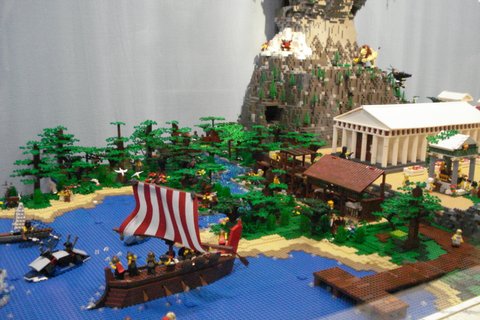
One of the interesting and worthwhile things I did this month was to lecture at the Surrey Museum. They were having a special lego exhibit and asked if I could do a slide presentation about ancient Greece which would include some aspects of travel.  I prepared a lecture of Armchair Travellers on Greek Myths and Muses which included some of the ancient heroes and legends as well as part of the Venetian and Byzantine history of Greece.  All the photos other than those borrowed from Wikipedia were taken by me on various journeys around Greece. 


ATHENS, Parthenon


At first I wasn't sure how the Lego exhibit connected with my lecture, but after having a look at it I realized that many of the places I spoke about in my talk were included as exhibits, such as these remarkable structures of Athens's acropolis and Parthenon. And there was even ancient Troy, which was included in my lecture about Homer's heroes Agamemnon and Achilles.


The display, built by the Vancouver LEGO club presented the world of gods and goddesses, heroes and monsters from ancient times and mythology. There were sets of lego on the tables for children to try their hand at building some structures themselves.  And there was also an interactive 'game' where kids could find certain items in the display and check them off on a paper.  I was more than impressed by this show and it certainly enhanced the subjects I talked about in my lecture.

Egypt, the Sphinx and pyramids

The Lighthouse of Alexandria