Showing posts with label customs. Show all posts

Thursday, January 03, 2013

THE IMPORTANCE OF RESEARCH

Add to Technorati Favorites


Writing historical fiction can mean that a lot of time is spent doing research.  I try to limit this time for myself (because I love researching!) by making sure exactly what I want and need to find out.
There's lots of info available on-line now but it is still a good idea to visit  your library and find some of the books written on the subjects you want to know about.

Not everyone has been as lucky as I have in actually being able to visit some of the places that I am writing about. Even though some are now just archaeological ruins, you can still get the idea of the way things might have been, along with visits to the local museums and all the book research you've done. Certain things can't be 'fictionalized' and you need to be as correct as possible when describing habits, customs and locations of the places in your novels.


For my novel "Dragons in the Sky" I really lucked out when I discovered the Iron Age Celtic village at St. Fagan's Heritage Park near Cardiff Wales. Not only did I see first-hand what the houses were like people lived in back in the days I was writing about, but you could go inside the houses as well. There were people in period costume demonstrating what went on inside the houses as well as some of the materials and possessions Iron Age people would have.

I also visited the site where my story first takes place, Old Sarum on the Salisbury Plain in the south of England, and the remains of the hill fort which gave me some idea of what the terrain was like where my fictional village of Caer Gwyn was located.

But there were still lots of details I needed to know about the life of the Brythonic Celts.  So I went back to the books and spent a couple of weeks jotting down bits of trivia (eating and drinking habits, warriors customs such as the chopping off of enemy's heads and keeping them for trophies. And I had to learn as much as I could about the healing arts, potions and spells so I could add these details to the story. Now I must go back over what I previously had written and add these little tidbits of information which is going to make Olwen's story even more realistic and visual.

Although I am writing a strictly fiction account of this young Celtic priestess's abduction and journey across Europe to Macedonia, I still have to get certain facts straight. I have learned the names of all the tribes and some interesting facts about them. I figured out travel times (by horse) and was able to scope some of the terrain on the google maps. It's been an interesting journey so far. And I want to make it as realistic as possible so that the people come alive and are believable.

It bothers me sometimes when historical fiction writers just second-guess at details and don't take time to make sure that what they have written is logical or truthful. Yes, it is 'fiction', but if you are including historical facts, those details must be correct. As for your interpretation of the characters you have a lot of leeway and, as the saying goes "The historical fiction writer can take as many liberties as they wish in making it a better story".  When I wrote "Shadow of the Lion", I was writing from a historically recorded plot-line so much of the novel had to be correct. Luckily I had some Classical Scholar friends in Greece who helped me with some small details like the way sacrifices and offerings were made etc, what they wore, what they ate. And I was able to interpret my characters according to what research I had done about them. I was also fortunate to be able to visit many of the locations in my story, to study flora and fauna and the lay of the land. It helped me describe things in a very realistic way so that the reader can imagine being there.

"Dragons in the Sky" is not written from a historical plot-line but at some point in the story when Olwen meets Alexander, there are certain events that must be recorded accurately. I can fictionalize her view-point of these events, but historians would have objections if I had things happening with Alexander that were not possible. So I have returned to my big box of research notes that I have kept from "Shadow", and this has really been helpful to me in plotting out the next part of "Dragons."

Remember, when you write historical fiction, you must do the work. Otherwise you are bound to have readers who throw the book down saying 'this is all nonsense'. Make your fiction as realistic as you can get it, make the characters live and breath, laugh and cry. That's what makes a great story!


Tuesday, March 20, 2012

THE PERSIAN NEW YEAR: AN EXCERPT FROM 'SHADOW OF THE LION'

This is a chapter segment from "Shadow of the Lion" in which the Persians are celebrating their New Year (Nowruz).  I did a lot of research for this chapter, however it is one that is cut from the final draft. In this scene, the royal entourage is at Troy awaiting the ships that will carry them to Thrace, on their way to Macedon.  They have been informed that once they leave Troy they will not be allowed to worship their god as is their custom so this is their last Nowruz.


            The ceremony began at sundown. A ram’s horn sounded the summons for the
Persians to gather in the courtyard. Everyone came dressed in their finery for the occasion
and took their places in order of rank. Roxana and her ladies, including Leila, who were all
from noble families, sat on carpets on one side. Nabarzanes, the stewards, the Warder,
and visiting envoys stood in a circle around the stack of juniper logs for the New Year’s
pyre. The eunuchs, servants and slaves stayed behind them.

          The chanting started with a single voice but soon others joined in. As if in answer
came the soft beat of a tabor and the thin wail of a reed flute. The Magus entered the
courtyard, accompanied by the child and two acolytes who bore the sacred fire altar. As
the people shouted loud hosannas and spread palm branches in their path, the Magus raised
his want to bless them. Everyone laid on the ground and pressed their foreheads ot the
stones in obesience.

          The child shone like a jewel beside the dignified snowy-bearded priest who was
garbed in ceremonial garments of pure white. The Magus moved toward the altar and
washed his hands three times in the basin of clean spring water held by an acolyte. On the
altar was a small bowl containing grain roasted with salt, and seeds. Beside it were placed
baskets of figs, dates and dried herbs. Another dish held honey and another contained milk. He offered the grain and seeds at the altar and burned them for the God. Then he poured the honey and milk into a bronze offering dish ad set it on the ground in front of the altar, placing the baskets of fruit and herbs on the ground beside it.

          In a clear, pious voice, the Magus sand the anthem. There was an absolute silence as he sang the sacred words.
            “He is the God of all things
  The Fire of heaven and earth, sky and wind.
             He is the power of life and the power of death.
            All things that grow and fill the universe are His.”

            The old priest’s hands shook as he lifted the flask of purified water and drank from
it. As he blessed the oil and poured some for the God, a sudden sound from beyond the stone walls stopped his voice. There was a long, murmuring hush, then a sigh of relief as the marching footsteps of guards calling out their rounds for the night watch retreated. The Magus stood in an attitude of prayer, his hands on his forehead.
      “We must pray for peace between all nations, food for the hungry, and steadfastness in the face of many hardships,” he said. He bowed to the child, hand toforehead, and spoke the words of worship and adoration.
            “Lord, O light of all mankind, O Lord who sees all things,
            Upon the Shah who stands in awe of Thee
            Confer thy bounteous blessings...”
           Then he broke pieces of sandalwood and placed them in the fire holder, drank again from the consecrated water, and emptied the flask to east and west, sprkling some on the door lintels.
           “Rejoice with the fruits of the earth,” he cried.
          
             As the sacred offering burned, the thrum of a harp shimmered around the courtyard.


                  An acolyte threw a torch into the pile of logs. Jubilant cheers filled the courtyard. Cymbals clanged and tabors rattled. The blazing logs drenched everything in gold. Even the walls and pillars seemed to be burning. The Magus raised his wand and the people lifted their hands to sing the anthem of praise to the sky, sun and stars.

                 It was a glorious night. The air was blue with smoke and fragrant with the resin-scent of burning juniper. Above, in the clear- star-filled sky, the new moon hung like the curved blade of a shimshir. Just next to it, Venus shone brightly as a beacon.
                    The child drank in everything; the bright flames, the dazzle of light reflecting off  gold and jewelry. His rears rang from the din of the music. He looked around and saw his mother standing motionless, sparkling in the firelight. A strange power seemed to  radiate from her that made a tingling sensation prickle down his spine. He felt like crying, but did not know why. He looked over at Leila and gave her a hesitant smile. If he could have, he would run to her for reassurance, but it would not be seemly to behave like a baby.

                 The music of flutes and strings began. Hands clapped, drums and cymbals beat. Dancers began to twirl to the skirling of reed pipes and the rich lilting tune of the ivory flute. In the midst, with skirts and jewels swinging, arms entwined, the women wove and  twisted, swaying to the beat. He saw his mother, laughing as if she had no dread, no cares in the world, as she lead the dance.
                 Suddenly he was nudged forward, caught in her beckoning hands. She whirled him round and round, his feet flying over the stones as he laughed with delight, caught in the rhythm of the joyful dance.

                 Some of the men began to leap over the flames, calling on Atar the Fire, to bring them good fortune. Mesmerized by the hypnotic cadence of the music, the child held his breath as they jumped and twirled, daring the flames to scorch them. Their ululating grew louder and the dance became more frenzied, until finally the flames burned down to embers and the drum-beats slowed to a faint thudding. The fire dancers sank to the ground in a trance, beads of sweat streaming down their faces, their eyes glazed with rapture.

                Then the kitchen slaves announced that the feast was ready. The child took his
place beside the Magus seated on a dais raised above the heaps of pillows where the guests reclined. The entire floor was covered with dining cloths except for narrow spaces where the servants moved about carrying trays heaped with food.
                 There was pheasant cooked in pomegranate juice; whole roasted lambs; piglets stuffed with apples and pistachios; marrows and melons and fruits of every variety;pastries drenched in honey and little cakes made with almonds, dates and cloves. Before the feasting began the Magus blessed the special Nauruz foods: the sprouted grains; the purple hyacinth petals; the sweet puddings; the ripe black olives their brine of vinegar and herbs; the russet apples saved from the autumn harvest.
            “This is the time of thanksgiving and bestowing gifts,” he announced in his high,
ancient voice. “It is the way we have celebrated the New Year since the old days when Shah Kyros proclaimed it to be a festival of friendship.” He laid his hand on the child’s head. “The Shah, our Honored One, is always the first to be served.”
            Nabarzanes tucked an embroidered napkin over the front of Iskander’s coat.
        “Iskander-shah, I won’t even scold you today if you spill anything or talk with your
mouth full,” he whispered good-humouredly. “This napkin has been used by all the Persian
Shahs since the time of the Great Kyros, Father of Persia.” He stood, and addressed the
banquet guests. Voices grew silent as he began his speech.
            “Our Shahs, the First Darius and Xerxes the Destroyer, were hated by the Greeks.
The Greeks say we Persians stole sacred treasures from the High Place in Athens and
drove their priests out of the temples. Because of this, Persians are not tolerated in
Greece, so when we go to Macedon, we will be prohibited from practicing our customs.”
            He spoke in the high-bred Elamite tongue of the Persian royalty, in a voice deep-toned as
a nefer. His brows were drawn over his nose in a stern expression. “Shah Kyros, the lord’s Annointed, ruled over many nations. Even though they did not speak the same language or worship the same God as Persia he believed that all men are God’s children, so he made those whom he conquered -- Medes, Assyrians, Babylonians, Soghdians, Bactrians -- one kingdom. We must try to live in peace and accord with the Macedonians.” He looked down upon the child with a compassionate smile. “Iskander-
shah, your father the Invincible Alexander, also believed in the union of all nations. He honored our God and paid tribute to the Great Kyros. You are a fortunate child, for you have been born into the best of two worlds. May you always be proud of who you are, and rule as wisely as your father and the Great Shah Kyros.” He bowed low before the child in a gesture of respect. In his eyes were both pride and grief. “The people of Persia look to you as their Shah now. You must live well and endure, for the sake of us all.”

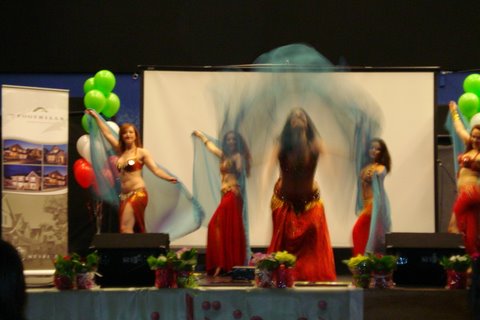
 The photos are from the Persian New Year (No-rooz) that I attended on the weekend to celebrate the Spring Equinox.

Sunday, November 30, 2008

PROGRESS REPORT #45: PROMISES


ME, ON MY WEDDING DAY

What do you remember about your wedding day? Do you remember feeling scared, nervous, excited, overwhelmed? Did you have any questions lurking in your mind whether you were doing the right thing or not? What do you remember about your wedding ceremony and the reception afterwards? I remember mine was beautiful. My father married me which was an honor and thrill. And the reception was at the church, with all the church ladies helping with the catering. My new husband's family planned a reception of their own afterwards. Ukranian style. None of my wedding party were invited and to this day I don't know why and should have insisted they come. It was a party where whiskey flowed freely and it carried on for 3 days. (Not that I was there. We had headed down to the States for a brief honeymoon.)

I've been thinking about this as I worked on this recent segment of Shadow of the Lion. I know what Thessaloniki is getting herself into. What I didn't know, when I was a young bride, all starry-eyed and 'in love', was that my future wouldn't exactly turn out as I'd hoped with a fairy-tale ending. How many people's do? Did yours?

What did I, a preacher's daughter from a Christian home, only a kid and very innocent, know about disfunctional families? What did I know about families from other cultures? Nothing.
Maybe if I had, I'd have been cautious. But back then, girls really were geared into marriage at an early age and my parents were very anxious to have me marry this man who they thought very much of. How could we know what would happen less than 10 years later?

There are so many customs attached to marriage. This was another interesting aspect of writing this short piece about preparations for a wedding in ancient Greece. Today we of the Western culture are aghast at 'arranged' marriages, but they go on in quite a few cultures just as they did back in the old times. And actually, even when I was getting married, if the parents disapproved, no way would permission be given. So in some respects, in a lot of places times haven't changed. Our traditional 'white' weddings only started with Queen Victoria and became part of our British culture after that. In other countries brides don't dress in white. And lately I've seen brides even wearing black!

I wonder if other cultures they have the 'something borrowed, something blue' custom? In ancient Greece the brides wore either yellow or red veils to signify 'fire' (the flame of passion, I guess) and a tear-drop diamond reflected that fire.

My wedding dress was made by my mother. (I still have it!) She very lovely sewed it and stiched on the lacy trim and tiny seed pearls. It was a beautiful dress and still is. I bring it out now and then to admire it. Today it seems brides are spending extravagant amounts of wedding dresses.

The girls were usually married very young (at 18 you'd be a has-been) and the father chose the groom. Poor Thessaloniki got gyped out of that ritual and got to make her own choice. But did she make a good one? I wonder, that day when Thessaloniki was marrying Kassandros if she had any idea of what the future held for her. She was marrying to 'escape', and because she was frightened of Olympias and by then was considered to be an 'old' spinster, overlooked and abused. Her father Philip had been assassinated before he ever found a groom for her; her half-brother Alexander, took off on his quest to conquer the world and never gave her a thought. She was the off-spring of one of Philip's many campaign wives, and because she was a girl, she was inconsequential. Can you blame her for jumping at the chance to marry a man, the son of the deceased Regeant, from the most powerful clan in Macedon. Little did she know what she was in for, or that she had made a bargain with the devil.


A BRIDE PREPARES FOR HER WEDDING

Thessaloniki stood before the tall copper mirror and carefully inspected herself. It was her wedding day, a day of despair for some women, but for her a day of rebirth. Today she would marry Kassandros, a man who had promised her freedom and a name.

Months had gone by since she had last seen him. There had been no formal pledge as tradition dictated because she had no male family member who would swear before the groom to guarantee she would produce children. Nor did she bring to her marriage a dowry other than, as heiress, her family’s estate.

It was a full moon night, not the favorable month of Gamelion, sacred to Hera the marriage guardian. Even so the seers had boded good fortune. The preparations had been made as Kassandros had ordered, the great Hall garlanded and couches set out for a grand feast. On a dais, chairs of honour for the women attendants flanked a flower-decked throne for the bride. She had invited all her courtiers, ladies of high standing, wives of senior officers, ambassadors and envoys. It had been many years since she could remember such a celebration had been held in the palace.

She stood in front of the gilded mirror and drew in a slow breath. She wore a veil of yellow silk and a simple gown of fine white byssus edged with gold threads; on the shoulder was clasped the ornate brooch Kassandros had given her and at her throat a single tear-drop diamond that had once belonged to her mother.

She had never taken pride in her body, but now she saw its usefulness: the full hips well formed and right for child-bearing, the breasts large, voluptuous; she would bear royal children. Critically, she surveyed her face: her straight nose, high brow, large sorrowful dark eyes. She looked always as she were sulking, her face ravaged by grief. Now though, she felt a quiet dignity, a certain triumph. She smiled, and her image softened, her mouth turned up becomingly, her eyes brightened with hope. Her new husband’s prospects would guarantee her a life of ease, free from all the every day concerns that had, in the past, confronted her. Olympias had thought her inconsequential; the Soghdian had scorned and threatened her. She had little recollection of her own mother; even her father, Philip, had paid her little heed. She had always been lost in the shadow of her remarkable half-brother, Alexander, who had not even cared enough to arrange a marriage for her before he left on his conquests. She had been the forgotten princess, but now Kassandros offered her a chance for fame and good fortune. Kassandros promised to protect her and even name a city after her. No other Macedonian princess could claim that honour. He had already begun clearing out the villages along the gulf, laying the plans for the new metropolis, one he said that would outshine Pella. And if things went his way, Kassandros would soon become the Regent and she would help him rule Macedon.

She went to the altar and lit the incense in its censor. Sweet smoke curled up permeating the room with it’s fragrance. She called upon her father’s Shade to ask his blessing, but did not utter the name of Alexander. She poured a libation of costly myrrh from a golden cup into a bejewelled bowl, speaking aloud the name of the godess in reverence as decreed.

“Golden-throned Hera, wife of almighty Zeus, immortal queen, protector of brides, give me a sign!” Motionless, she waited long for the goddess to speak but silence
was her only answer.

Down in the courtyard the torches blazed and she could hear the sound of flutes and kitheras mingled with the joyous cries of the wedding guests.. The wedding processional was gathering. She heard the maidens singing the refrain of the sacred marriage song. “Ho, Hymen! Ho, Hymen! Hymenaeos! Io!” Soon they would come to lead her to the nuptials. She felt her midriff clutch with nervous tension, then she threw back her shoulders and gave a deep sigh of satisfaction. She had waited all her life for this day.


NOTE: Well Kassandros did keep one promise to her. The city of Thessaloniki is named for her and of all the memorials to Alexander's time, it still exists and thrives as the second biggest city in Greece.

Add to Technorati Favorites
Posted by Picasa