"I travel light; as light,
That is, as a (woman) can travel who will
Still carry (her) body around because
Of its sentimental value."
Christopher Fry 1907 - "The Lady's Not for Burning." 1950 Act 1
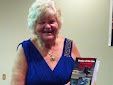
I started writing travel stories back in 1980 when I realized that to get a major work published, such as a novel, I would need some publsihing experience. I'd had a background in journalism -- my first job after high school was as a copy-runner in the editorial department of The Vancouver Sun newspaper. I wanted to be a crime reporter. The City Editor would't hear of an eighteen year old preacher's daughter sitting on the News Desk. So I ended up being a news librarian, honing my research skills, in charge of the crime files which proved to be a fascinating career move!
I sent out my very first travel article in 1982 to a travel trade magazine and voila! it was published and I got paid good money for it. Shortly after that I went to live in Greece, and began sending travel stories about my new home to The Globe and Mail newspaper (Canada's national newspaper). Everything I submitted was published. And that began my career as a travel journalist. Since then, I've had many articles published in a number of newsapeprs and magazines. Unfortunately I'm not as agressive a marketer as I should be, and I'm also focused on my major work, The Great Unfinished Novel, besides other writing projects I have on the go and the lessons I teach. Travel journalism might sound like an appealing and romantic 'career' but to tell the truth, these days it's getting more difficult to find publishers, in particular ones who want to pay you any kind of real money. Newspapers tend to use their own staff writers or their news services for stories and very few freelancers. Magazines also have staff writers. So you have to be constantly on the look-out for new markets, ones that will pay!
That's why I turned to teaching travel writing (and other writing courses)in order to support my writing habit and not have to work at a 'real' job. And finally, after all these years, I seem to have found the fine balance. As well, I have been lucky enough to glean a huge reward: I won a trip to Malaysia which was the door prize at a gala held by the B.C. Association of Travel Writers of which I'm a member. www.bctravelwriters.com (I have a little spot on there with my photo and a couple of my published articles under my real name W. Ruth Kozak)
This trip is a kind of 'reward' for all those stories that I got very little money (or nothing!) for.
I still can't believe this is true. Two more sleeps and I'm on the plane bound for Kuala Lumpur!
My fellow travel writer's from the Association are thrilled and pleased for me. Three of the women have been to Malaysia before on assignment trips, and they assure me I will be treated royally! The trip is fully paid for, five-star hotels, and other perks thrown in. Of course it is a kind of 'assignment' trip because I will definitely be writing some travel stories although the Malaysian tourism didn't specifically request this. It's a matter of saying 'thank's, a courtesy, and after all think of the fantastic sights I'm going to see!
One special tour that has been arranged (at my request) is a visit to the 14 acre estate of Rimbun Dahan which is the home of an architect and also the Center for Developing Traditional and Contemporary Art Forms. This idyllic tropical garden also hosts resident writers as well as artists. I've been in touch with the architect's wife (she writes for The Malaysian Naturalist and takes tours around the botanical gardens.) So, armed with my hand-held tape recorder and note book I hope to get a good interview and lots of excellent photos to illustrate the story I intend to write. You can see Rimbun Dahan for yourself on this web site:
http://www.rimbundahan.org/about
So for the next two weeks, blogger friends, you can find out all about Malaysia and my travels by logging onto my travel blog: http://travelthroughhistory.blogspot.com
I've already posted some preliminary blogs about Malaysia (pre-research for my trip) and it will give you an idea about where I will be visiting and some background about this fascinating country.
On Sunday, my friend and I are leaving on a jet plane (you can sing that line) from L.A. It's going to be a rather gruelling day's journey, leaving Vancouver at 3.15 pm., landing in L.A. two and a half hours later, then hanging around LAX for five hours before we board Malaysian Airlines for Kuala Lumpur, a 20 hr. 40 min. flight!!! (yikes!) with a brief stop-over in Taipei to change planes. (I wish the long lay-overs coming and going were in Taipei instead. That would be so much more exotic than L.A. But we did get an extra night in Kuala Lumpur (K.L.)
because of flight changes which is a bonus! )
My travel companion is an old friend, my namesake, who became my first girlfriend in Vancouver when my family moved here when I was 12. We don't see each other often now because she lives up-country, so this will a time for us to renew our long-time friendship.
Don't forget to blog onto my travel blog so you, too, can share in our amazing travel adventures! As they say in Malay: Selamat Jolan...goodbye! Have a good trip!
"For my part, I travel not to go anywhere, but to go.
I travel for travel's sake. The great affair is to move."
Robert Louis Stevenson 1850-1894 "Travels with a Donkey" 1878
Friday, March 17, 2006


Thursday, March 09, 2006
EDITING & REVISIONS: HOW MUCH IS ENOUGH BEFORE YOU MOVE ON?
"The Moving Finger writes; and having writ,
Moves on: nor all your Piety nor Wit
Shall lure it back to cancel half a Line,
Nor all your Tears wash out a Word of it."
Edward FitzGerald 1809-1883 "The Rubaiyat of Omar Khayyam" st. 17
Editing and Revisions. How much is enough? It seems, sometimes to be endless. So, when to stop? Being in a writer's critique group has helped me a lot when it comes to the revisions and additions needed to improve my novel. Because of this what I have already written, although the actual writing of it has taken a long time, is pretty well ready for 'final draft'. Of course I know I have to do a lot of cutting but I've already marked those passages that can easily be eliminated (though some will be difficult to cast out, I know they will simply have to go!)
Editing (such as line editing) can take such a long time and perhaps it's easiest to have a fresh eye look over the manuscript -- even if you have to pay to have it done. Otherwise, so much time is taken up while you meticulously search for errors like the proverbial 'needle in a haystack'.
That internal editor can be downright annoying, nit-picking, undermining your creativity by making you think your work isn't good enough. As Natalie Goldberg suggests in Writing Down the Bones, "The more clearly you know the editor, the better you can ignore it. After a while, like the jabbering of an old drunk fool, it becomes just prattle in the background... Meanwhile, you will continue to write."
Of course, the goal mustn't be simply to get the writing done, but to make the writing as good as it can be. This often means a lot of rewriting and revisions. There's different ways of doing this. Some writers plough right through to the end before doing a second, more perfected draft.
I prefer 'block editing' for my novel. That is, revising and editing in chapters or chapter segments. I do several drafts, then workshop, then revise and edit again, then move on. When I get writer's block, I'll go back over the last few chapters, do more revisions or editing and that gets me back into the cadence of the prose again so I can continue with the new chapter. That way I'm not leaving too much of a mess behind me which I'll just have to untangle and sort out later. For my shorter works, such a travel articles, I do several drafts, workshop, revise and edit and then they are usually ready to send off to market. Luckily most every article I've had published has had no further editing and is published word-for-word as I've submitted it.
I happen to like editing and do a lot of it for my classes. It doesn't take me long. Sometimes the revisions on my novel take longer (especially transitions, which I find sticky). But I've always got something on the go so that even when I have a 'block' with the novel I am still writing. Heaven knows I have a backlog of material for travel stories, but at the moment I am trying to focus only on the novel to get as much of it finished as possible before I get stuck again.
The question is, how much editing and revising is necessary before a writer should be satisfied and get on with something new? Hemingway admitted to revising a section of a novel thirty-seven times "to get the words right". Good writers take the time to recreate, revise, edit and proofread. This is all part of the writing process, and often the hardest work, because you must make sure that what you send off to an agent/publisher is as near-perfect as you can get it. Sloppy, amateurish work will quickly be delegated to the trash pile. But when to stop?
It's interesting to read some of the blogs of other writers and get their points of view on this and other writing subjects. These days writers (novelists, in particular) are expected to be working on other projects or at least have something else on the back-burner. Publishers like to know there's more than one novel in you. Book publishing is a money-making production these days so you have to be willing and able to produce if you want to become part of a publisher's 'stable' of writers. There are writers who seem content to endlessly edit and revise their work without ever starting anything new. "Send it out! Send it out!" they are urged, but they never do. Is it because they are afraid of turning their 'baby' out into the big competitive world? Are they afraid of rejection? (If you are afraid of rejection, you're in the wrong business because it's all part of being a writer.) Or perhaps they keep on editing because they don't want to start something new?
For me, editing and revisions are not such a chore except when I writing myself into a tangle like I probably did yesterday. I've avoided, since then, looking at what I'd written because I'm sure I'm going to have to start over. I tried revising a chapter by cut-and-paste and adding new ingrediants. I fear I have, in my zeal to get it finished, overdone it. Well, at least I can workshop it at my next critique group meeting and will be sure to get some practical advice on how to make it better. I know the editing and revisions are necessary, but I'm just so anxious to finish this novel (which has been taking me far too long to write) and get on with my other projects: another half-finished novel, a half-finished 2-act play, and a long list of travel articles yet to be written! Oh yes, and I do have an idea for a third novel as well which I'd very much like to get started on! Time to move on!
"Remember: good books aren't written; they are rewritten. Revision is a key phase of your novel writing. With short fiction pieces, it's advisable to put them aside and let them 'cool' for awhile. Only then can you go back to your own work with a fresh and somewhat objective eye and catch a few of your mistakes, though you'll never see them all. Fortunately, with a novel, when you've written your way through the last chapter, enough time will have passed so that you can return to the beginning with more objectivity, but even then you can't be entirely objective...
During revision you must become the critic. In the first writing, you give your story life; in the second, you get it right."
Phyllis A. Whitney, author, writing instructor
from an article Revisions and Rewrites: A Checklist" in The Writer magazine.
Moves on: nor all your Piety nor Wit
Shall lure it back to cancel half a Line,
Nor all your Tears wash out a Word of it."
Edward FitzGerald 1809-1883 "The Rubaiyat of Omar Khayyam" st. 17
Editing and Revisions. How much is enough? It seems, sometimes to be endless. So, when to stop? Being in a writer's critique group has helped me a lot when it comes to the revisions and additions needed to improve my novel. Because of this what I have already written, although the actual writing of it has taken a long time, is pretty well ready for 'final draft'. Of course I know I have to do a lot of cutting but I've already marked those passages that can easily be eliminated (though some will be difficult to cast out, I know they will simply have to go!)
Editing (such as line editing) can take such a long time and perhaps it's easiest to have a fresh eye look over the manuscript -- even if you have to pay to have it done. Otherwise, so much time is taken up while you meticulously search for errors like the proverbial 'needle in a haystack'.
That internal editor can be downright annoying, nit-picking, undermining your creativity by making you think your work isn't good enough. As Natalie Goldberg suggests in Writing Down the Bones, "The more clearly you know the editor, the better you can ignore it. After a while, like the jabbering of an old drunk fool, it becomes just prattle in the background... Meanwhile, you will continue to write."
Of course, the goal mustn't be simply to get the writing done, but to make the writing as good as it can be. This often means a lot of rewriting and revisions. There's different ways of doing this. Some writers plough right through to the end before doing a second, more perfected draft.
I prefer 'block editing' for my novel. That is, revising and editing in chapters or chapter segments. I do several drafts, then workshop, then revise and edit again, then move on. When I get writer's block, I'll go back over the last few chapters, do more revisions or editing and that gets me back into the cadence of the prose again so I can continue with the new chapter. That way I'm not leaving too much of a mess behind me which I'll just have to untangle and sort out later. For my shorter works, such a travel articles, I do several drafts, workshop, revise and edit and then they are usually ready to send off to market. Luckily most every article I've had published has had no further editing and is published word-for-word as I've submitted it.
I happen to like editing and do a lot of it for my classes. It doesn't take me long. Sometimes the revisions on my novel take longer (especially transitions, which I find sticky). But I've always got something on the go so that even when I have a 'block' with the novel I am still writing. Heaven knows I have a backlog of material for travel stories, but at the moment I am trying to focus only on the novel to get as much of it finished as possible before I get stuck again.
The question is, how much editing and revising is necessary before a writer should be satisfied and get on with something new? Hemingway admitted to revising a section of a novel thirty-seven times "to get the words right". Good writers take the time to recreate, revise, edit and proofread. This is all part of the writing process, and often the hardest work, because you must make sure that what you send off to an agent/publisher is as near-perfect as you can get it. Sloppy, amateurish work will quickly be delegated to the trash pile. But when to stop?
It's interesting to read some of the blogs of other writers and get their points of view on this and other writing subjects. These days writers (novelists, in particular) are expected to be working on other projects or at least have something else on the back-burner. Publishers like to know there's more than one novel in you. Book publishing is a money-making production these days so you have to be willing and able to produce if you want to become part of a publisher's 'stable' of writers. There are writers who seem content to endlessly edit and revise their work without ever starting anything new. "Send it out! Send it out!" they are urged, but they never do. Is it because they are afraid of turning their 'baby' out into the big competitive world? Are they afraid of rejection? (If you are afraid of rejection, you're in the wrong business because it's all part of being a writer.) Or perhaps they keep on editing because they don't want to start something new?
For me, editing and revisions are not such a chore except when I writing myself into a tangle like I probably did yesterday. I've avoided, since then, looking at what I'd written because I'm sure I'm going to have to start over. I tried revising a chapter by cut-and-paste and adding new ingrediants. I fear I have, in my zeal to get it finished, overdone it. Well, at least I can workshop it at my next critique group meeting and will be sure to get some practical advice on how to make it better. I know the editing and revisions are necessary, but I'm just so anxious to finish this novel (which has been taking me far too long to write) and get on with my other projects: another half-finished novel, a half-finished 2-act play, and a long list of travel articles yet to be written! Oh yes, and I do have an idea for a third novel as well which I'd very much like to get started on! Time to move on!
"Remember: good books aren't written; they are rewritten. Revision is a key phase of your novel writing. With short fiction pieces, it's advisable to put them aside and let them 'cool' for awhile. Only then can you go back to your own work with a fresh and somewhat objective eye and catch a few of your mistakes, though you'll never see them all. Fortunately, with a novel, when you've written your way through the last chapter, enough time will have passed so that you can return to the beginning with more objectivity, but even then you can't be entirely objective...
During revision you must become the critic. In the first writing, you give your story life; in the second, you get it right."
Phyllis A. Whitney, author, writing instructor
from an article Revisions and Rewrites: A Checklist" in The Writer magazine.
Friday, March 03, 2006
MAMWLAD FY NHAD: LAND OF MY FATHERS. AN ODE TO WALES ON ST. DAVID'S DAY
To be born Welsh
Is to be born privileged.
Not with a silver spoon
in your mouth
But music in your blood
And poetry in your soul.
On Wednesday morning this week, I woke up hearing Welsh music on the radio. It was St. David's Day, patron Saint of Wales. The songs I heard broadcast took me back in time because they were the songs I grew up hearing my Dad sing: All Through the Night; Myfanwy and
most particularly Guide me Oh Thou Great Jehovah. On the bookshelf by my bed is the picture of my father, looking handsome and proud in his Chaplain's uniform, showing the six medals he was awarded for service during W.W. II, which include the M.B.E. for bravery and compassion in the line of duty. Dad was a Chaplain in an army field hospital in Holland.
Before he emigrated to Canada in the early 30's, he had been a coal miner in the Rhymny Valley of South Wales. All the men in his family were miners and he worked down in the pits of the Bedwas Navigational Collieries from the time he was 14. When the mining troubles began in 1930 he lost his mining card because he was active in trying to improve conditions for the miners. So he left Caerphilly, his home, and came to Canada as a farm laborer. But soon after, he made himself known as an expert orator. He had often spoken in the mining chapels of Wales and his ability to preach got him an invitation to the McMaster University School of Theology even though he'd had no formal schooling past the age of 14. He became a Baptist minister and was sent to the troubled mining communities of the South Saskachewan to work alongside another young Baptist preacher from Scotland by the name of Tommy Douglas who later became the Premier of Saskatchewan for 16 years and the head of North America's first Socialist government.
As I listened to the Welsh music, many memories came back to me of my childhood. My Dad always sang wherever he went and often would burst into song in the midst of a serman at Church. He had a lovely tenor voice and he sang right up to the time of his death at age 89, back in 1991. The Welsh are known for their gift of song and poetry. The miners always sang to keep up their spirits. I grew up hearing Dad's mining stories and the tales of his childhood in Wales, and listening to the songs of my Dad's homeland.
When I started to write my w.i.p. Dragons in the Sky: A Celtic Tale I heard the Welsh intonation of a girl's voice telling me her story. Her name is Olwen. When I showed my Dad the early manuscript to see if he could hear the Welsh cadence in the prose, he commented about a Celtic holy place I have mentioned in my novel. Senghenydd. He ask me if I knew that Senghenydd was the name of the town where my great-grandfather and several of his uncles had been killed in a mining disaster back in 1904 just before he was born. I didn't know that. I had just read in my research about this Druid holy place in the south part of Wales.
A couple of years ago my cousin and I went to Senghenydd and saw the remains of the mine where our great-grandfather died, and we were even directed to his house. I have very deep roots in Wales and feel spiritually connected with the land and people. I have visited there often as some of my family (children of my father's brothers) live in Caerphilly. I have even visited the house where Dad was born while two of his younger brothers were still living there.
While I listened to the St. David's day tribute to Wales, the announcer mentioned a song that had been requested. It was titled The Dream of Olwen by Charles Smith. Much to my surprise, when the tune was played I recognized it as one that took me back to my grandpa's house in Stratford Ontario. I used to hear that song played as a theme song for a radio program my mother watched. I've always wanted to know the title of it and until Wednesday I had no idea that it was The Dream of Olwen. Olwen, the young protagonist of my novel! Strange how that unfinished w.i.p. has been so much on my mind lately, then suddenly they should play a familiar tune that had her name. Perhaps the Muse is trying to tell me something? Yet I cannot stop my work on my current novel at this point and return to the old manuscript. However lately I have had the yearning to visit Olwen's world again. So here is an excerpt from the first chapter of Dragons in the Sky. And hopefully, not too much longer and I'll be able to pick up from where I left off with her fantastic adventures. The story begins at an Iron Age hillfort on the Salisbury Plain near Stonehenge and her adventures, when kidnapped by a renegade Chieftain's son, lead her eventually to meet a remarkable young Prince, Alexander, who has just inherited the throne of his father in Macedonia where her captor has come to trade Celtic iron-wares.
(Note: some of the chapters of Dragons are written in Bardic verse. Others are a first-person narrative in Olwen's voice.)
Is to be born privileged.
Not with a silver spoon
in your mouth
But music in your blood
And poetry in your soul.
On Wednesday morning this week, I woke up hearing Welsh music on the radio. It was St. David's Day, patron Saint of Wales. The songs I heard broadcast took me back in time because they were the songs I grew up hearing my Dad sing: All Through the Night; Myfanwy and
most particularly Guide me Oh Thou Great Jehovah. On the bookshelf by my bed is the picture of my father, looking handsome and proud in his Chaplain's uniform, showing the six medals he was awarded for service during W.W. II, which include the M.B.E. for bravery and compassion in the line of duty. Dad was a Chaplain in an army field hospital in Holland.
Before he emigrated to Canada in the early 30's, he had been a coal miner in the Rhymny Valley of South Wales. All the men in his family were miners and he worked down in the pits of the Bedwas Navigational Collieries from the time he was 14. When the mining troubles began in 1930 he lost his mining card because he was active in trying to improve conditions for the miners. So he left Caerphilly, his home, and came to Canada as a farm laborer. But soon after, he made himself known as an expert orator. He had often spoken in the mining chapels of Wales and his ability to preach got him an invitation to the McMaster University School of Theology even though he'd had no formal schooling past the age of 14. He became a Baptist minister and was sent to the troubled mining communities of the South Saskachewan to work alongside another young Baptist preacher from Scotland by the name of Tommy Douglas who later became the Premier of Saskatchewan for 16 years and the head of North America's first Socialist government.
As I listened to the Welsh music, many memories came back to me of my childhood. My Dad always sang wherever he went and often would burst into song in the midst of a serman at Church. He had a lovely tenor voice and he sang right up to the time of his death at age 89, back in 1991. The Welsh are known for their gift of song and poetry. The miners always sang to keep up their spirits. I grew up hearing Dad's mining stories and the tales of his childhood in Wales, and listening to the songs of my Dad's homeland.
When I started to write my w.i.p. Dragons in the Sky: A Celtic Tale I heard the Welsh intonation of a girl's voice telling me her story. Her name is Olwen. When I showed my Dad the early manuscript to see if he could hear the Welsh cadence in the prose, he commented about a Celtic holy place I have mentioned in my novel. Senghenydd. He ask me if I knew that Senghenydd was the name of the town where my great-grandfather and several of his uncles had been killed in a mining disaster back in 1904 just before he was born. I didn't know that. I had just read in my research about this Druid holy place in the south part of Wales.
A couple of years ago my cousin and I went to Senghenydd and saw the remains of the mine where our great-grandfather died, and we were even directed to his house. I have very deep roots in Wales and feel spiritually connected with the land and people. I have visited there often as some of my family (children of my father's brothers) live in Caerphilly. I have even visited the house where Dad was born while two of his younger brothers were still living there.
While I listened to the St. David's day tribute to Wales, the announcer mentioned a song that had been requested. It was titled The Dream of Olwen by Charles Smith. Much to my surprise, when the tune was played I recognized it as one that took me back to my grandpa's house in Stratford Ontario. I used to hear that song played as a theme song for a radio program my mother watched. I've always wanted to know the title of it and until Wednesday I had no idea that it was The Dream of Olwen. Olwen, the young protagonist of my novel! Strange how that unfinished w.i.p. has been so much on my mind lately, then suddenly they should play a familiar tune that had her name. Perhaps the Muse is trying to tell me something? Yet I cannot stop my work on my current novel at this point and return to the old manuscript. However lately I have had the yearning to visit Olwen's world again. So here is an excerpt from the first chapter of Dragons in the Sky. And hopefully, not too much longer and I'll be able to pick up from where I left off with her fantastic adventures. The story begins at an Iron Age hillfort on the Salisbury Plain near Stonehenge and her adventures, when kidnapped by a renegade Chieftain's son, lead her eventually to meet a remarkable young Prince, Alexander, who has just inherited the throne of his father in Macedonia where her captor has come to trade Celtic iron-wares.
(Note: some of the chapters of Dragons are written in Bardic verse. Others are a first-person narrative in Olwen's voice.)
* * *
The God speaks and says:
Blood red is the snow; as
blood red as the ragged
leaves of the elder trees.
In Ruis, the Elder month, we made sacrifcies to the Sun God at the winter solstice. The Druid slaughtered a white roebuck and divined the omens in the blood splattered snow. But the gods were not appeased, and Boreas, the North Wind, blew down freezing blizzards across the Plain, burying our village in drifts that reached higher than the edges of the roof thatch.
We huddled in our huts around peat fires, wrapped in furs like hibernating animals, until finally some of us tunneled out through the drifts to snare winter hares and track white stag in the forest.
Supplies of smoked meat and fish dwindled with each passing storm, and rafters that had been heavy with drying fruit and roots were bare. While we counted out the last of the bundles of food and herbs, we muttered oaths ot the gods. It seemed that year we were not in their favour.
My guardian, Essylt, was a medicine woman and high priestess of our cult. She was small and bright-eyed, lively as a sparrow; but that winter seemed to tire her, and she began to look grey and care-worn. As the wind howled outside our wattled hut she brooded and I saw her watching the flames of the hearth fire, staring silently as though her thoughts had drifted off to other worlds. She kept me busy taking votive offerings to the woodland shrine. The snow was too deep on the trail for her to struggle through, but I made a child's game of it, and kept the pathway trampled clear, carrying offerings of things like dried berries, cups of grain and sometimes a sprig of mistletoe.
The winter's cold took its toll. Almost every day Essylt went out to administer medicines, or to say some words of enchantment agains the Raven of Death. We could not wait for the spring thaw to lay our dead in their barrows, so the bodies were burned on pyres outside the palisade. Most of the victims of the raw weather were the old ones, but once a little child wandered out into a storm and froze, buried in a snowbank. I saw them carrying him home, like a stiff little pup, wrapped in a wolfskin. It grieved me for days, and in spite of the wind and the drifts that reached above my knees, I struggled to the woodland shrine, bringing the last sprigs of vervain to make a supplication to the Mother Goddess.
It was my thirteenth year with the Druids. I had learned all the incantations of magic before I was ten years old. Essylt, being a sorceress and diviner of the auguries, was both my guardian and my teacher. I called her modryb, Auntie, because she had nursed me in my infancy as though she were my natural mother. The Druid said my real mother died in childbirth. I would have been exposed for the wolves if someone had not brought me to the Great Stone Circle on the Plain.
Listen to my song: I am
an honoured child. I am
Olwen, daughter of the Earth Mother,
Child of the Raven.
I will be the pinecone
clinging to the branch.
The wind will not dislodge me.
I will be the coral
on the sea reef.
The waves will not displace me.
I will be the stone dolman
of the sacred Henge.
Neither time nor elements will distrub me.
I will be the willow
bending in the wind.
I will be the wave
uncurling on the sea.
I will be the mountain
my pinnacle crowned with sun.
Steadfast I will stand.
Monday, February 27, 2006
PROMPTING THE MUSE
"Let us sacrifice to the Muses."
Solon 638-559 BC from "Plutarch - The Banquet of the Seven Wise Men."
For a couple of years now I've been teaching a class called Prompting the Muse. This is a writing class designed to motivate people who need their creativity jump-started or to get people who want to write, to get started. In the class I give prompts, and the students can write any genre and in any form such as prose, poetry, plays, essays etc. It's always interesting and often very exciting to see the results.
Some example of what kind of prompts I use in class and for weekly assignments include writing from music, visual prompts, one liners, monologue, observations, writing haiku, exercises in point of view and dialogue and flash fiction (stories written from a picture in which they have 5 minutes to write whatever the picture invoked.) It's a lot of fun and really gets people's creative juices stimulated. I also encourage 10 minute timed writings on any subject, random or by choice, every day. These stream-of-conciousness writings often can be expanded and developed into longer stories.
I use the same prompt technique in the Memoirs Write from the Heart group that I instruct once a week. As in my Prompts class, besides the weekly assignments we do 10 minute writings in the class. Examples of these are: Practical jokes; A metaphor that likens the self to an inanaimate object ("I am a fan" "I am a book.") and how it relates to your personality; Have you ever fibbed to save your skin? Write about your mother's kitchen, etc. Of course I also use music in this class too, because songs invoke many memories.
Last week in my Memoir class we had an assignment that had such amusing and creative results I decided to try it myself on my other blog http://ruthakik.blogspot.com
This assignment was: Imagine two or more sides of yourself as distinct characters each with reasons to be angry with or love and need the other part.
As I'm always talking to myself (my other blog is titled "Conversations with Myself") I decided to try it. And you can too. Just see what you and your alter-ego have to say to each other. It's quite intriguing. And it's fun, too! I've also written the one about likening yourself to an inamiate object, and I might post that next.
These little 'prompts' are a good exercise to get yourself started. That being said, I better return to work on the novel. I know, I said I'd get started right away today. But it's Monday, and I had to do the laundry and after such a busy weekend I needed some time to get my head back together again. Okay...enough excuses...off you go!
"When toilsome contests have been decided, good cheer is the best physician, and songs, the sage daughters of the Muses, soothe with their touch."
Pindar 518- 428 BC "Nemean Odes" IV l 1
"Whatever a poet writes with enthusiasm and a divine inspiration is very fine."
Democrites 460- 370 BC fragment 18 (apparantly the earliest reference to the madness or divine inspiration of poets.)
Solon 638-559 BC from "Plutarch - The Banquet of the Seven Wise Men."
For a couple of years now I've been teaching a class called Prompting the Muse. This is a writing class designed to motivate people who need their creativity jump-started or to get people who want to write, to get started. In the class I give prompts, and the students can write any genre and in any form such as prose, poetry, plays, essays etc. It's always interesting and often very exciting to see the results.
Some example of what kind of prompts I use in class and for weekly assignments include writing from music, visual prompts, one liners, monologue, observations, writing haiku, exercises in point of view and dialogue and flash fiction (stories written from a picture in which they have 5 minutes to write whatever the picture invoked.) It's a lot of fun and really gets people's creative juices stimulated. I also encourage 10 minute timed writings on any subject, random or by choice, every day. These stream-of-conciousness writings often can be expanded and developed into longer stories.
I use the same prompt technique in the Memoirs Write from the Heart group that I instruct once a week. As in my Prompts class, besides the weekly assignments we do 10 minute writings in the class. Examples of these are: Practical jokes; A metaphor that likens the self to an inanaimate object ("I am a fan" "I am a book.") and how it relates to your personality; Have you ever fibbed to save your skin? Write about your mother's kitchen, etc. Of course I also use music in this class too, because songs invoke many memories.
Last week in my Memoir class we had an assignment that had such amusing and creative results I decided to try it myself on my other blog http://ruthakik.blogspot.com
This assignment was: Imagine two or more sides of yourself as distinct characters each with reasons to be angry with or love and need the other part.
As I'm always talking to myself (my other blog is titled "Conversations with Myself") I decided to try it. And you can too. Just see what you and your alter-ego have to say to each other. It's quite intriguing. And it's fun, too! I've also written the one about likening yourself to an inamiate object, and I might post that next.
These little 'prompts' are a good exercise to get yourself started. That being said, I better return to work on the novel. I know, I said I'd get started right away today. But it's Monday, and I had to do the laundry and after such a busy weekend I needed some time to get my head back together again. Okay...enough excuses...off you go!
"When toilsome contests have been decided, good cheer is the best physician, and songs, the sage daughters of the Muses, soothe with their touch."
Pindar 518- 428 BC "Nemean Odes" IV l 1
"Whatever a poet writes with enthusiasm and a divine inspiration is very fine."
Democrites 460- 370 BC fragment 18 (apparantly the earliest reference to the madness or divine inspiration of poets.)
Thursday, February 23, 2006
I'M WRITING AS FAST AS I CAN!
"The beginnings and endings of all human undertakings are untidy, the building of a house, the writing of a novel, the demolition of a bridge, and eminently the finish of a voyage."
John Galsworthy 1867-1933 "Over the River" 1933 ch 1.
There are times, I'm certain any novel-writer will agree, that the writing becomes overwhelming as the project keeps getting bigger and bigger and wandering away. As the story progresses, you get to know your characters better, allowing them to take you off on tangents of their own design until it seems you are lost in this other-world you have created and there doesn't seem to be any light at the end of the convoluted tunnel.
When I started writing Shadow of the Lion I had in mind that it would only take me about a year. I intended it to be a juvenile historical novel about the short and tragic life of Alexander the Great's son, a short novel for young readers.
After a year of writing (which had followed a year of intensive research) I realized the story was far too political and complicated to be absorbed by a young audience. To do it justice, it had to be told in a different, more "Homeric" way. I was advised by a published juvenile author to just go ahead and write it the way I felt it should be written. So I started over, writing it from a multiple point of view. In time, the theme changed from a rites-of-passage to a more political theme: How blind ambition and greed brought down a world power. It became not only the story of the boy, Iskander (Alexander IV), but the more complex story about the end of Alexander's dynasty. Little did I realize, when I made the decision to switch from a juvenile historical to a more complicated adult historical, that the novel would take me so long to complete.
I recall how disappointed I was when I read Mary Renault's Funeral Games which covers the same period of history. To me the story seemed to be 'documented', with a lack of character development and not a lot of tension in the plot. I know it was her last book and she was elderly by then, so perhaps she had rushed it through to finish it. My novel follows the same period of time, and I constantly refer back to hers to see how she fit in the complex political issues and intrigues between the Successors of Alexander. But in my novel I've chosen to develop the key characters more extensively, especially the women who are fascinating individuals who have never been given a fair recognition by the historians. The child, too, is little known. He lived a tragic life, born just after his eminent father died suspiciously in Babylon, used as a pawn in the battle between the Successors, dragged around from camp to camp for the first years of his life and at the age of thirteen, just before he was able to legally rule as king, he was imprisoned and finally murdered by his father's life-long enemy Kassandros, who sought to claim the throne for himself.
This kind of story has taken endless years of research, in libraries, and on site, and lucky for me, while I have lived in Greece I have been privileged to not only visit some of the places I write about, but I've talk to Classical scholars and archaeologists who are experts on the subject.
Still, the research seems endless and often, like the other day, I end up spending several hours looking up some small detail (which I found on the internet, an amazing tool for researchers!)
There have been times when the well ran dry and I couldn't write, had to set the manuscript aside for awhile, then get a fresh start. There are other times when I am writing constantly, almost non-stop. The story has consumed my life. In between working on it, I am always writing something: journals, blogs, memoirs. I spent two years revising my play The Street, for its successful production, then began to write a second play (House of the Muses, about the lyric poet Sappho, as yet unfinished). Of course there's my travel journalism which is a source of a small amount of income (and certain rewards such as my forthcoming trip to Malaysia). But the novel seems endless and sometimes I wonder if it will ever be finished! Although I am close to the end now, it's a daunting task. Then comes the job of cutting, because I am already in such deep water I have enough written for at least three books and it has to be chopped down to a handy 500 pages. though I'm not too worried about the editing as I already have a clear picture of what can be cut without ruining the plot-line.
I was looking at the phenomenal word-count the other day and started telling myself maybe I should be cutting corners, skipping over some of what I have already outlined to write. But no, I've decided to carry on and cut later. I'm writing as fast as I can but there are days when I feel like a mouse on a treadmill, getting nowhere fast. I'm a slow writer, meticilous, block editing as I go along with the help of my wonderful critique group. So what I've written so far is pretty well a near-final draft. However, I'm asking myself "When will it be over?"
I've got another half-written Celtic tale waiting -- one I set aside when I started this project, thinking "It's a juvenile historical. It will only take me about a year to write!" I have to admit I'm enjoying the journey. I know the characters as well as I know my friends. It's been an exciting world to get lost in. But like all journeys it has to eventually come to an end.
"A man may write at any time, if he will set himself doggedly to it."
Samuel Johnson 1709-1784 From James Boswell, "Life of Johnson" (1791) Nov. 5, 1728
John Galsworthy 1867-1933 "Over the River" 1933 ch 1.
There are times, I'm certain any novel-writer will agree, that the writing becomes overwhelming as the project keeps getting bigger and bigger and wandering away. As the story progresses, you get to know your characters better, allowing them to take you off on tangents of their own design until it seems you are lost in this other-world you have created and there doesn't seem to be any light at the end of the convoluted tunnel.
When I started writing Shadow of the Lion I had in mind that it would only take me about a year. I intended it to be a juvenile historical novel about the short and tragic life of Alexander the Great's son, a short novel for young readers.
After a year of writing (which had followed a year of intensive research) I realized the story was far too political and complicated to be absorbed by a young audience. To do it justice, it had to be told in a different, more "Homeric" way. I was advised by a published juvenile author to just go ahead and write it the way I felt it should be written. So I started over, writing it from a multiple point of view. In time, the theme changed from a rites-of-passage to a more political theme: How blind ambition and greed brought down a world power. It became not only the story of the boy, Iskander (Alexander IV), but the more complex story about the end of Alexander's dynasty. Little did I realize, when I made the decision to switch from a juvenile historical to a more complicated adult historical, that the novel would take me so long to complete.
I recall how disappointed I was when I read Mary Renault's Funeral Games which covers the same period of history. To me the story seemed to be 'documented', with a lack of character development and not a lot of tension in the plot. I know it was her last book and she was elderly by then, so perhaps she had rushed it through to finish it. My novel follows the same period of time, and I constantly refer back to hers to see how she fit in the complex political issues and intrigues between the Successors of Alexander. But in my novel I've chosen to develop the key characters more extensively, especially the women who are fascinating individuals who have never been given a fair recognition by the historians. The child, too, is little known. He lived a tragic life, born just after his eminent father died suspiciously in Babylon, used as a pawn in the battle between the Successors, dragged around from camp to camp for the first years of his life and at the age of thirteen, just before he was able to legally rule as king, he was imprisoned and finally murdered by his father's life-long enemy Kassandros, who sought to claim the throne for himself.
This kind of story has taken endless years of research, in libraries, and on site, and lucky for me, while I have lived in Greece I have been privileged to not only visit some of the places I write about, but I've talk to Classical scholars and archaeologists who are experts on the subject.
Still, the research seems endless and often, like the other day, I end up spending several hours looking up some small detail (which I found on the internet, an amazing tool for researchers!)
There have been times when the well ran dry and I couldn't write, had to set the manuscript aside for awhile, then get a fresh start. There are other times when I am writing constantly, almost non-stop. The story has consumed my life. In between working on it, I am always writing something: journals, blogs, memoirs. I spent two years revising my play The Street, for its successful production, then began to write a second play (House of the Muses, about the lyric poet Sappho, as yet unfinished). Of course there's my travel journalism which is a source of a small amount of income (and certain rewards such as my forthcoming trip to Malaysia). But the novel seems endless and sometimes I wonder if it will ever be finished! Although I am close to the end now, it's a daunting task. Then comes the job of cutting, because I am already in such deep water I have enough written for at least three books and it has to be chopped down to a handy 500 pages. though I'm not too worried about the editing as I already have a clear picture of what can be cut without ruining the plot-line.
I was looking at the phenomenal word-count the other day and started telling myself maybe I should be cutting corners, skipping over some of what I have already outlined to write. But no, I've decided to carry on and cut later. I'm writing as fast as I can but there are days when I feel like a mouse on a treadmill, getting nowhere fast. I'm a slow writer, meticilous, block editing as I go along with the help of my wonderful critique group. So what I've written so far is pretty well a near-final draft. However, I'm asking myself "When will it be over?"
I've got another half-written Celtic tale waiting -- one I set aside when I started this project, thinking "It's a juvenile historical. It will only take me about a year to write!" I have to admit I'm enjoying the journey. I know the characters as well as I know my friends. It's been an exciting world to get lost in. But like all journeys it has to eventually come to an end.
"A man may write at any time, if he will set himself doggedly to it."
Samuel Johnson 1709-1784 From James Boswell, "Life of Johnson" (1791) Nov. 5, 1728
Thursday, February 16, 2006
BEING A TRAVEL WRITER HAS SOME PERKS
The road to the City of Emerald is paved with yellow bricks."
Lyman Frank Baum 1856- 1919 "The Wonderful Wizard of Oz"
Being a travel writer definitely has some perks. If you read my travel blog at
http://travelthroughhistory.blogspot.com you will read some preliminary entries to the trip I am going on to Malaysia in just a couple of weeks. I won this trip as a door-prize at a gala last Spring held by the B.C. Association of Travel Writers, of which I am a member of. It's an all-expense paid trip to this tropical paradise, five star hotels and city tours: 3 days in Kuala Lumpur at the Mandarin Oriental Hotel, then 3 days on the island of Langkawi at the Langkawi Lagoon Resort. We paid for an additional 4 days at this resort and then were given an extra day in K.L. on our return. The trip was for two except for the air fare. As my sister was unable to come with me, one of my long-time friends is coming along. Both of us are thrilled beyond words at this stroke of luck. Of course, it's a kind of 'assignment' for me as I will be expected to write some stories about Malaysia. I'm looking forward to that too!
Because I'm a member of the BCATW I get a few perks thrown in, such as invitations to media shows and receptions. Last weekend it was a special reception and art exhibit presented by Tourism New Zealand. We met at the Spirit Wrestler Gallery to view an amazing display of Maori and Northwest Coastal Native art. Later we went to a wine reception at the Fairmont Waterfront Hotel (rather posh) and then a reception buffet- banquet which was attended by many First Nations people as well as the visiting Maori artists. It was fascinating watching the procession of elders and the greeting ceremonies. Then a delicious banquet was served of various foods, produce from New Zealand (except for the donated fresh salmon of our Pacific Coast) all prepared by the N.Z. chef. Quite an extravagent event. We even got to meet the N.Z. High Commissioner and his wife, lovely people, so gracious. I've always wanted to visit N.Z. so this just whet my appetite.
I've been busy teaching my night school classes lately and this week I also was invited to teach a travel writing class at one of the colleges where my friend teaches journalism. That was another bonus, as it pays really well and is an inspiring experience for me too. My writing classes are: Novel Writing, Prompting the Muse (writing from prompts) and Travel Writing. All of them are enjoyable but the Travel Writing is always the most fun. I love hearing about other people's amazing trips and showing them how to write about them in an interesting and entertaining way, whether for articles, blogs, journals, or creative non-fiction stories.
You don't make a lot of money freelancing these days, so I supplement my writer's 'income' by teaching classes, which is most enjoyable. And then of course, comes tax time and I submit a 'self employment' return and as I am a travel writer and must travel to do this, all the expenses I incur are deducted (as well as other writing related expenses). This generally pays for my next trip. And as the Malaysia trip is pretty well 'free' except for spending money, I am hoping that later this year I can afford to go to Chile. And that will not only be a travel writing trip but a sentimental journey to see the places my friend A. always talked about and spend time with his lovely ex who has invited me there.
So, in spite of not making a ton of money for my writing, there are these other 'perks' which make it all worthwhile. (I should add the dozens of pens and other doo-dads I collect whenever I go to a travel media show!) Not to speak of the interseting schmoozing that goes on. Now I'm aiming for more FAM trips in future. I figure I've earned it!
"Setting out on a voyage to Ithaca
you must pray that the way be long,
full of adventures and experiences."
Constantine Peter Cavafy 1863-1933 "Ithaca" 1911 l.11
Lyman Frank Baum 1856- 1919 "The Wonderful Wizard of Oz"
Being a travel writer definitely has some perks. If you read my travel blog at
http://travelthroughhistory.blogspot.com you will read some preliminary entries to the trip I am going on to Malaysia in just a couple of weeks. I won this trip as a door-prize at a gala last Spring held by the B.C. Association of Travel Writers, of which I am a member of. It's an all-expense paid trip to this tropical paradise, five star hotels and city tours: 3 days in Kuala Lumpur at the Mandarin Oriental Hotel, then 3 days on the island of Langkawi at the Langkawi Lagoon Resort. We paid for an additional 4 days at this resort and then were given an extra day in K.L. on our return. The trip was for two except for the air fare. As my sister was unable to come with me, one of my long-time friends is coming along. Both of us are thrilled beyond words at this stroke of luck. Of course, it's a kind of 'assignment' for me as I will be expected to write some stories about Malaysia. I'm looking forward to that too!
Because I'm a member of the BCATW I get a few perks thrown in, such as invitations to media shows and receptions. Last weekend it was a special reception and art exhibit presented by Tourism New Zealand. We met at the Spirit Wrestler Gallery to view an amazing display of Maori and Northwest Coastal Native art. Later we went to a wine reception at the Fairmont Waterfront Hotel (rather posh) and then a reception buffet- banquet which was attended by many First Nations people as well as the visiting Maori artists. It was fascinating watching the procession of elders and the greeting ceremonies. Then a delicious banquet was served of various foods, produce from New Zealand (except for the donated fresh salmon of our Pacific Coast) all prepared by the N.Z. chef. Quite an extravagent event. We even got to meet the N.Z. High Commissioner and his wife, lovely people, so gracious. I've always wanted to visit N.Z. so this just whet my appetite.
I've been busy teaching my night school classes lately and this week I also was invited to teach a travel writing class at one of the colleges where my friend teaches journalism. That was another bonus, as it pays really well and is an inspiring experience for me too. My writing classes are: Novel Writing, Prompting the Muse (writing from prompts) and Travel Writing. All of them are enjoyable but the Travel Writing is always the most fun. I love hearing about other people's amazing trips and showing them how to write about them in an interesting and entertaining way, whether for articles, blogs, journals, or creative non-fiction stories.
You don't make a lot of money freelancing these days, so I supplement my writer's 'income' by teaching classes, which is most enjoyable. And then of course, comes tax time and I submit a 'self employment' return and as I am a travel writer and must travel to do this, all the expenses I incur are deducted (as well as other writing related expenses). This generally pays for my next trip. And as the Malaysia trip is pretty well 'free' except for spending money, I am hoping that later this year I can afford to go to Chile. And that will not only be a travel writing trip but a sentimental journey to see the places my friend A. always talked about and spend time with his lovely ex who has invited me there.
So, in spite of not making a ton of money for my writing, there are these other 'perks' which make it all worthwhile. (I should add the dozens of pens and other doo-dads I collect whenever I go to a travel media show!) Not to speak of the interseting schmoozing that goes on. Now I'm aiming for more FAM trips in future. I figure I've earned it!
"Setting out on a voyage to Ithaca
you must pray that the way be long,
full of adventures and experiences."
Constantine Peter Cavafy 1863-1933 "Ithaca" 1911 l.11
* * *
TRAVEL READING
This probably doesn't fit in the TBR Challenge, but here goes:
TITLE: "Dinner with Persephone: Travels in Greece"
AUTHOR: Patricia Storace
YEAR PUBLISHED: 1996, Vintage Departures, Vintage Books (Div of Random House NY)
WHY DID YOU GET THIS BOOK? My travel companion was reading it on our trip to Greece last summer and loaned it to me.
DO YOU LIKE THE COVER? The cover has a picture of a succulent pomegrante, Aphrodite's fruit of love. Quite appealing.
DID YOU ENJOY THE BOOK? Yes. The book was not simply a travelogue but written with a great deal of scholarship. It provided a lot of information and anecdotes about Greek life, customs, superstitions, myths and history.
WAS THE AUTHOR NEW TO YOU AND WOULD YOU READ SOMETHING BY THIS AUTHOR AGAIN? Patricia Storace is the author of a book of poems and won a prize for poetry from the American Academy of Arts and Letters. She has published essays but this is her first book of prose. I would read her future books.
ARE YOU KEEPING IT OR PASSING IT ON? I must return it to my friend.
ANYTHING ELSE? I enjoyed the book, in particular some of the anecdotes and stories about famous Greeks, in particular the tragic story of Penelope Benaki, daughter of the famous Benaki family whose home is now the Benaki Museum in Athens. She survived a harsh and unhappy life and became Greece's first children's writers, under the name of Penelope Delta.
Sadly, she killed herself with poison when the Germans invaded Greece in the '40's.
Some things I didn't like about the book were that is often went on too long with historical background and not too many exciting 'travel' experiences of the author which slowed the pace. In the final chapters about Ayvalik (Aivali) and Istanbul, Turkey, I disagreed with some of the commentary regarding the Turkish women. I've visited both Ayvalik (once) and Istanbul (several times since 1975) and also other west coast Turkish cities as recently as 2004, and did not frequently find women dressed in 'ugly long overcoasts' and veils. Mostly they were in modern western dress or the colourful pantaloons the village women wear. They are not so cloistered as the author seemed to portray them, though some of her facts are correct. I felt she was observing the more liberal Turkish Muslims from a critical and closed American P.O.V. and she was only there for a brief time so wasn't interacting much with the locals. As for her observations of Greek village life and customs, having lived in a tiny shepherd's village in the mountains of Evvia for part of the five years I spent living in Greece, I agreed with most of her comments. "Dinner with Persephone" is an interesting book, in particular if you have little knowledge of the country and people of Greece. My friend, who was making her first visit to Greece when she read it, found the book very informative.
Monday, February 06, 2006
OFF THE PAGE and Other Writer's Events
"The only thing I was fit for was to be a writer,
and this notion rested solely on my suspicion
that I would never be fit for real work, and that
writing didn't require any." Russell Baker 1925 - "Growing Up." 1982 ch 9
Looking back, I must have started writing as soon as I could grasp a pencil and spell out the words. At the age of ten I was writing short plays for my classmates, mostly plays about the war (WW2) and fairy tale plays to be acted out for the entertainment of my neighbourhood playmates. After Dad came home from the war, when my family travelled by train across the wide expanse of the Canadian prairies and through the Rocky Mountains to the west Coast, at the age of twelve, I imagined myself a pioneer, and began to write longer stories about the early frontier settlers. By the time I was sixteen and got my first real typewriter, I had expanded my stories to short-novel length and wrote about Biblical and Roman history. I wrote all through my junior and high school years, often entertaining my classmates during Study Hall with the latest chapters of my novels.
There was little encouragement then, for aspiring young writers like me. Although some of my grad. class women still recall the stories I'd read out in class (one of them about a circus trapeze star who I saw fall from him high trapeze to the arena floor -- miraculously not killed but badly injured) most teachers didn't encourage me. My mother was often called to the school and told that if I paid more attention to Math and Science and less about day-dreaming in my imaginary worlds I would be a better student.) All I ever wanted to be was a writer. Math and Science meant nothing to me. History and Literature were my forte. And at one time I aspired to be an actor. That too was discouraged.
Nowdays kids have so many more opportunities and are encouraged to follow their aspirations. Schools are focusing more on litarary and writing programs for students. One of these programs is "Off The Page" sponsored by the Federation of B.C. Writers with the backing of a special grant. Members of the Fed. are invited to go to schools (any grade from kindergarten up) to talk to the children about writing and to share their experiences of being a writer. I've been a part of this program for three years now and find it a most rewarding experience. (You can read about it on the Fed website at www.bcwriters.com
Check out "Off the Page" and look for my bio under W. Ruth Kozak).
Last week I was invited to visit a grade 6/7 class who are currently studying the novel and planning to write novellas themselves. They had already studied 'setting' and 'characterization' and were now working on 'plot'. I took along some of my early manuscripts, written when I was twelve and one from when I was sixteen to demonstrate certain points such as character description and the important first page, introducing character, setting and hinting at the conflict. I read an excerpt from the one story which was the first thing I had published, aged twelve, in a CGIT magazine. It was about a Dutch war orphan, the idea gleaned from watching news reels and listening to stories my Dad had told from when he was stationed in Holland during the war. (I talked to the children about where I find story ideas and how I eventually focused mainly on historical fiction.)
We played a plotting game where I give them a story line and 3 characters. Two children who have been brought up in luxury are suddenly orphaned and placed in the care of an avaricious, nasty old Aunt. They have to invent a fourth character and plot out the story. They were working in groups of six and were so enthusiastic the room was a buzz of young voices. Later each group presented their story, which included an introduction to the characters. They were so eager to do another exercise like this and the teacher promised that after the lunch break they could turn their stories into plays and practice some play writing.
It was an exciting and inspirational morning for both the children and myself and the teacher was so pleased with the results he asked if I could come back another time. Of course I said I'd be more than happy to return. As I told the children, they are lucky to have these opportunities to explore and develop their creative talents. I would have given anything during my school years if such a program had been offered.
That day set off a weekend of other pleasant events which included attending a Board meeting for the Pandora's Poetry Collective. I am on the Board of this very active poetry group who are doing remarkable things with young people in the community. You can read about them on their website at www.pandorascollective.com . If you check under "Executive Board" you'll find my name W. Ruth Kozak. (For any of you who are poets, they offer programs and contests for adults as well as children).
In addition, next week I've been invited to attend the journalism class my friend teaches at Kwantlan College to present a workshop on travel writing. I've done this for a couple of years as well and it's another inspiring experience.
So this past week, including the three night school classes I teach and the Memoir group on Thursday mornings, has been focused mostly on writing. I found myself too exhausted to do my own writing though, and have lagged behind in work on my novel. So now I must try and catch up.
At last the sun is shining after weeks and weeks of rain and terrible wind storms which made travelling to and fro from my classes by bus a real chore. With the sunshine my energy has returned and so has my inspiration. I'm looking forward to my weekly critique group, The Scribblers, tonight and we'll we welcoming a couple of new members. And the next three nights are my classes which are dyanmite groups this term. As is the Memoir group on Thursday mornings. Their stories never fail to amaze me.
So here I am, all those years later, from the first time I wrote down my little stories and plays and shared them with my classmates, really living the writer's life. It has taken a lot of perseverence, determination and the willingness to live on a shoestring, trusting that eventually some editor will publish my work, but it's all worth the effort. As I told the children, you have to hang onto your dream, be determined and focused and practice your craft daily just as a musican must practice every day, and eventually you will be successful.
"A teacher who can arouse a feeling for one single good action,
for one single good poem, accomplishes more than he who
fills our memory with rows on rows of natural objects, classified with name and form."
Johann Wolfgang von Goethe "Elective Affinities" bk II ch 7. 1749-1832
and this notion rested solely on my suspicion
that I would never be fit for real work, and that
writing didn't require any." Russell Baker 1925 - "Growing Up." 1982 ch 9
Looking back, I must have started writing as soon as I could grasp a pencil and spell out the words. At the age of ten I was writing short plays for my classmates, mostly plays about the war (WW2) and fairy tale plays to be acted out for the entertainment of my neighbourhood playmates. After Dad came home from the war, when my family travelled by train across the wide expanse of the Canadian prairies and through the Rocky Mountains to the west Coast, at the age of twelve, I imagined myself a pioneer, and began to write longer stories about the early frontier settlers. By the time I was sixteen and got my first real typewriter, I had expanded my stories to short-novel length and wrote about Biblical and Roman history. I wrote all through my junior and high school years, often entertaining my classmates during Study Hall with the latest chapters of my novels.
There was little encouragement then, for aspiring young writers like me. Although some of my grad. class women still recall the stories I'd read out in class (one of them about a circus trapeze star who I saw fall from him high trapeze to the arena floor -- miraculously not killed but badly injured) most teachers didn't encourage me. My mother was often called to the school and told that if I paid more attention to Math and Science and less about day-dreaming in my imaginary worlds I would be a better student.) All I ever wanted to be was a writer. Math and Science meant nothing to me. History and Literature were my forte. And at one time I aspired to be an actor. That too was discouraged.
Nowdays kids have so many more opportunities and are encouraged to follow their aspirations. Schools are focusing more on litarary and writing programs for students. One of these programs is "Off The Page" sponsored by the Federation of B.C. Writers with the backing of a special grant. Members of the Fed. are invited to go to schools (any grade from kindergarten up) to talk to the children about writing and to share their experiences of being a writer. I've been a part of this program for three years now and find it a most rewarding experience. (You can read about it on the Fed website at www.bcwriters.com
Check out "Off the Page" and look for my bio under W. Ruth Kozak).
Last week I was invited to visit a grade 6/7 class who are currently studying the novel and planning to write novellas themselves. They had already studied 'setting' and 'characterization' and were now working on 'plot'. I took along some of my early manuscripts, written when I was twelve and one from when I was sixteen to demonstrate certain points such as character description and the important first page, introducing character, setting and hinting at the conflict. I read an excerpt from the one story which was the first thing I had published, aged twelve, in a CGIT magazine. It was about a Dutch war orphan, the idea gleaned from watching news reels and listening to stories my Dad had told from when he was stationed in Holland during the war. (I talked to the children about where I find story ideas and how I eventually focused mainly on historical fiction.)
We played a plotting game where I give them a story line and 3 characters. Two children who have been brought up in luxury are suddenly orphaned and placed in the care of an avaricious, nasty old Aunt. They have to invent a fourth character and plot out the story. They were working in groups of six and were so enthusiastic the room was a buzz of young voices. Later each group presented their story, which included an introduction to the characters. They were so eager to do another exercise like this and the teacher promised that after the lunch break they could turn their stories into plays and practice some play writing.
It was an exciting and inspirational morning for both the children and myself and the teacher was so pleased with the results he asked if I could come back another time. Of course I said I'd be more than happy to return. As I told the children, they are lucky to have these opportunities to explore and develop their creative talents. I would have given anything during my school years if such a program had been offered.
That day set off a weekend of other pleasant events which included attending a Board meeting for the Pandora's Poetry Collective. I am on the Board of this very active poetry group who are doing remarkable things with young people in the community. You can read about them on their website at www.pandorascollective.com . If you check under "Executive Board" you'll find my name W. Ruth Kozak. (For any of you who are poets, they offer programs and contests for adults as well as children).
In addition, next week I've been invited to attend the journalism class my friend teaches at Kwantlan College to present a workshop on travel writing. I've done this for a couple of years as well and it's another inspiring experience.
So this past week, including the three night school classes I teach and the Memoir group on Thursday mornings, has been focused mostly on writing. I found myself too exhausted to do my own writing though, and have lagged behind in work on my novel. So now I must try and catch up.
At last the sun is shining after weeks and weeks of rain and terrible wind storms which made travelling to and fro from my classes by bus a real chore. With the sunshine my energy has returned and so has my inspiration. I'm looking forward to my weekly critique group, The Scribblers, tonight and we'll we welcoming a couple of new members. And the next three nights are my classes which are dyanmite groups this term. As is the Memoir group on Thursday mornings. Their stories never fail to amaze me.
So here I am, all those years later, from the first time I wrote down my little stories and plays and shared them with my classmates, really living the writer's life. It has taken a lot of perseverence, determination and the willingness to live on a shoestring, trusting that eventually some editor will publish my work, but it's all worth the effort. As I told the children, you have to hang onto your dream, be determined and focused and practice your craft daily just as a musican must practice every day, and eventually you will be successful.
"A teacher who can arouse a feeling for one single good action,
for one single good poem, accomplishes more than he who
fills our memory with rows on rows of natural objects, classified with name and form."
Johann Wolfgang von Goethe "Elective Affinities" bk II ch 7. 1749-1832
Tuesday, January 31, 2006
MUSIC AND THE MUSE
"All art constantly aspires towards the condition of music."
Walter Pater 1839-1894 "The School of Gerogione"
A specific piece of music can conjur many memories and set you in the mood for the Muse to speak. I often call on Euterpe the Muse of lyric poetry, or Polyhymnia, the Muse of songs for the gods to inspire me while I am writing.
Sometimes, when I'm beginning a new piece of writing I prefer to work in silence. But often, if I play the right music, something that sets me in the 'mood' and 'place' of the piece I am working on, the words flow more easily.
The music that's played in the Iatlian coffee shop where I often go to relax and jot down notes is always Italian music, sometimes popular songs or folk music and often opera. When I was writing my play The Street which is set in the '50's in Vancouver's East End, I would write lines of dialogue while at the Calabria, because the family in the play were Italian immigrants and being there seemed to give me the right 'flavour'. I used music to evoke memories of that time and as the play is partly autobiographical, I had clear images of events and personal experiences associated with the music we used to listen to.
Some of these songs, a lot of them jazz tunes by Chet Baker, Billy Holiday and Rosemary Clooney, were actually played during the performance or at the intermissions. One song in particular brought me back immediately to my youth and still does. To this day I recall clearly how my boyfriend Jimmy (about whom the play was written) loved to sing "Sweet Lorraine" The memory used to be so strong that often it made me cry as I remembered my first love and those tender years when I was so strongly affected by the tragic events that occured when he became a heroin addict. That song, and other, such as Angel Eyes evoke strong memories of that time in my life.
I am very particular what I listen to while I'm writing my historical fiction novel. In the beginning, when the setting was in Babylon I used to play Persian music. Now I prefer some music from movies, or classical pieces such as those by Yo Yo Ma. If I'm not careful what I'm listening to it can be distracting rather than inspiring.
I found an excellent CD in Greece which I play when I am working on my w.i.p. drama,
House of the Muses, which is about the life of the lyric poet Sappho who Plato described as
"The Tenth Muse." The music is by a Greek composer, Angelique Ionatos, who write it to accompany Sappho's lyric poetry (because Sappho sang her poems accompanied by the lyre.)
"Sappho de Mytilene" is one of my favorite CD's. The songs are sung by the composer
and another well-known Greek singer, Nena Venetsanou accompanied by instruments such as the guitar, our, tabor and oboe.
In the writing classes I teach, I often use music as a prompt and we write whatever imagry that particular music conjurs. And music is also a good way to relax and allow your creativity to take you into other worlds in particular if you are suffering from the dreaded 'writer's block'.
What kind of music do you like to listen to when you are writing? Or do you prefer silence?
A peculiar thing is, if I happen to be on a 'roll' with my writing, I can go to my favorite bistro where there's either jazz or Latino music playing, and will be able to jot down notes that may come into my head completely oblivious to what is going on around me. I guess if the Muse is there, she's going to prompt you no matter what.
"And Music's power obey
From harmony, from heavenly harmony,
This universal frame began:
From harmony to hamony
Through all the compass of the notes it ran..."
John Dryden 1631-1700 A Song for Saint Cecilia's Day 1687 st. 1
"De la musique avant toute chose,
Et pour cela prefere l"Impair.
Music above all, and for this
Choose the irregular."
Paul Verlaine 1844-1896 "Jardins Et Naguere 1884 L'Art Poetique"
Walter Pater 1839-1894 "The School of Gerogione"
A specific piece of music can conjur many memories and set you in the mood for the Muse to speak. I often call on Euterpe the Muse of lyric poetry, or Polyhymnia, the Muse of songs for the gods to inspire me while I am writing.
Sometimes, when I'm beginning a new piece of writing I prefer to work in silence. But often, if I play the right music, something that sets me in the 'mood' and 'place' of the piece I am working on, the words flow more easily.
The music that's played in the Iatlian coffee shop where I often go to relax and jot down notes is always Italian music, sometimes popular songs or folk music and often opera. When I was writing my play The Street which is set in the '50's in Vancouver's East End, I would write lines of dialogue while at the Calabria, because the family in the play were Italian immigrants and being there seemed to give me the right 'flavour'. I used music to evoke memories of that time and as the play is partly autobiographical, I had clear images of events and personal experiences associated with the music we used to listen to.
Some of these songs, a lot of them jazz tunes by Chet Baker, Billy Holiday and Rosemary Clooney, were actually played during the performance or at the intermissions. One song in particular brought me back immediately to my youth and still does. To this day I recall clearly how my boyfriend Jimmy (about whom the play was written) loved to sing "Sweet Lorraine" The memory used to be so strong that often it made me cry as I remembered my first love and those tender years when I was so strongly affected by the tragic events that occured when he became a heroin addict. That song, and other, such as Angel Eyes evoke strong memories of that time in my life.
I am very particular what I listen to while I'm writing my historical fiction novel. In the beginning, when the setting was in Babylon I used to play Persian music. Now I prefer some music from movies, or classical pieces such as those by Yo Yo Ma. If I'm not careful what I'm listening to it can be distracting rather than inspiring.
I found an excellent CD in Greece which I play when I am working on my w.i.p. drama,
House of the Muses, which is about the life of the lyric poet Sappho who Plato described as
"The Tenth Muse." The music is by a Greek composer, Angelique Ionatos, who write it to accompany Sappho's lyric poetry (because Sappho sang her poems accompanied by the lyre.)
"Sappho de Mytilene" is one of my favorite CD's. The songs are sung by the composer
and another well-known Greek singer, Nena Venetsanou accompanied by instruments such as the guitar, our, tabor and oboe.
In the writing classes I teach, I often use music as a prompt and we write whatever imagry that particular music conjurs. And music is also a good way to relax and allow your creativity to take you into other worlds in particular if you are suffering from the dreaded 'writer's block'.
What kind of music do you like to listen to when you are writing? Or do you prefer silence?
A peculiar thing is, if I happen to be on a 'roll' with my writing, I can go to my favorite bistro where there's either jazz or Latino music playing, and will be able to jot down notes that may come into my head completely oblivious to what is going on around me. I guess if the Muse is there, she's going to prompt you no matter what.
"And Music's power obey
From harmony, from heavenly harmony,
This universal frame began:
From harmony to hamony
Through all the compass of the notes it ran..."
John Dryden 1631-1700 A Song for Saint Cecilia's Day 1687 st. 1
"De la musique avant toute chose,
Et pour cela prefere l"Impair.
Music above all, and for this
Choose the irregular."
Paul Verlaine 1844-1896 "Jardins Et Naguere 1884 L'Art Poetique"
Monday, January 23, 2006
POLITICS Greek: POLITIKA
POLITICS: The art or science of government; the art or science concerned with guiding or influencing governmental policy; the art or science concerned with winning and holding control over a government.
"Politics are almost as exciting as war, and quite as dangerous. In war you can only be killed once, but in politics many times."
Sir Winston Spencer Churchill 1874-1965 Remark: 1920
Federal Election Day in Canada. I'm writing this with the background sound of the winning party (our new Prime Minister) making his victory speech, interspersed with the cheers of the crowd. No, I didn't vote for this Party because their leader is a right-wing Conservative who opposes a lot of rights such as gay marriages, "Pro Choice" for abortions, and is inclined to favour policies of our Southern neighbour in regards to the war in Iraq and other issues. (See how long it takes before he's in Bush's pocket like Tony Blair.) At least the Party I voted for got 10 new representatives elected who include a fine woman from my district who is always there acting on behalf of the poor, elderly and working-class people.
It so happens that while all these weeks of Campaigning have been going on, I've been delving into the politics of ancient times. While I listened to the political rhetoric, watched the politicians posturiing, making promises that may or may not be kept (likely not); and slamming each other I couldn't help but make a few comparisons. Things don't really change. There's always corruption. Good men get taken down when the populace turns against them.
In the case of my novel, one of the victims of the citizen's fickleness was the military governor of Athens, Phokion, a man of great integrity, elected as stageiros many times, and one who always tried to put the good of the people first. In the end, he became another victim in the power struggle between Alexander's Successors.
In this scene, which takes place in Athens, the City Councillors have just received news that the Macedonian army is approaching the city. They had been issued an edict by Polyperchon, the Macedonian Regent, offering them a return to democratic rule and allowing a number of exiles to return to their homes. (The exiles, mostly democrats, had been driven off their land by the aristocrats who favoured the oligarchies and supported the occupation of Athens by the Macedonian garrison.) The Councillors accuse Phokion of not acting by refusing to accept the edict and insisting the garrison be removed.
"You see!" shrilled an elder Councilman, wagging a finger in Phokion's face. "It is your fault this has happened. You should have made it clear to Polyperchon that the terms of the edict are unacceptable to us."
"Yes!" shouted Chares, a stout balding man, one of his most vocal opponents. "It seems the Macedonians have deployed more troops to increase their military power here. We have demanded that the garrison be removed but you, Phokion, seem to be sided with the aristocrats who are friends of Macedon. Are you a coward, Phokion? Have you lost your spirit?"
Phokion responded to the insult in his usual terse and dignified manner. He peered at them sternly under his thick brows and retorted. "You may call me a coward, Chares, and a man of no spirit because I have refused to act irrationally on these important issues. You can not make me bold, and I cannot make you cowards. But we kow very well what each of us really is."
Charles laughed at his reply. "You lower your brows, Phokion, and put on airs as though you were above us and you show us this by ignoring our demands."
"At least this brow of mine has never caused you any harm, Chares, but the laughter of those who are now sneering at me has given the city plenty to regret. Do not forget that Athena, our city's Patron Goddess, presides over the arts of both war and peace. I have sought to find a peaceful solution, one that will benefit Athens and satisfy Macedon."
One of the staunch democrat senators stood to speak. "We have had enough of Macedonian domination. We want to rule our city by our own democratic laws."
"My friend," Phokion replied. "First, make sure of your own safety. It is better to intercede with the Macedonians than to fight them. It is my recommendation that the Athenians fight using words, in which we have an advantage, not weapons, in which we are inferior."
The Hall burst into a hostile cacophony of hisses and cat-calls.
"You can make me act against my wishes," Phokion said, his voice loud and formidable as a general addressing his troops. "You will never make me speak against my judgement. I will not allow my fellow citizens to destroy themselves even if you wish it so."
He leaves the Council Hall and makes his way up to the Pnyx Hill where a huge crowd has gathered. The General in charge of the Pireaus and the district of Munychia where the garrison is located is about to make a speech.
General Dercyllus height and brawn made him an imposing figure. His booming voice rang out over the Assembly.
"In the past weeks, I have observed a steady deployment of troops from the garrison at Munychia to the island of Salamis. Even as I speak, the harbour at Zea is full of Macedonian warships. It is rumoured that Kassandros will soon return from his mission to Asia Minor with more naval reinforcements. I saw we should seize the port and make it secure before we are surrounded on both land and sea."
The crowd roared their support in a cheer that resounded from the heights of the Acropolis rock.
Dercyllus continues his speech and reveals a plan to arrest the garrison commander and seize the garrison. Phokion protests, reminding the Athenians of how the Thebans and their city were destroyed when they had tried to overthrow the Macedonians.
"I warn you, it will be hubris to overstep your authority, Dercyllus. In the past I have always dealt fairly with Philip, and Alexander. And when Alexander was away on campaign, Antipater. I will also negotiate peacefully with Polyperchon. I will not agree to make war on Macedon or to seize the garrison. Remember what happened to the Thebans? They were destroyed when they tried to rebel." He was aware he was trembling, and sweat trickled from his brow in spite of the coolness of the day.
Dercyllus refuses to listen and the crowd backs him up.
Amid their hostile insults and jeers, Phokion stepped down and made his way along the stony path from the Pnyx toward the sanctuary of his home on the Hill of the Nymphs. He felt angry, but reminded himself of his duty. What should he do to combat Dercyllus' threats? He was friends of both men, and it was not in his nature to turn traitor. But he must warn Nikanor of the dangers he faced if he addressed the Council in Pireaus.
When he arrived home, he ordered a messenger to be sent to the garrison with an invitation to Nikanor of Strageira to dine with him that night.
During the course of the dinner, Phokion conveys a warning to the garrison commander.
He spoke slolwy, measuring each word. "I am an Athenian, and you are not. I have lived long enough to know this: nothing is stronger in the Athenians than their will to possess their own city. When Macedon put the garrison here, they made themselves enemies who are only biding their time before they revolt. You can see this now -- that the City is about to erupt. Beware, Nikanor, of malice at your back. The demos is like a pack of wolves ready to take anyone down who opposes them."
"I will keep my guard, Sir, "Nikanor said. "I do not wish to work against the Athenians. We were posted here to protect them."
"Protect them? Against whom?"
"Against themselves, Sir. You know their history. And you remember well what befell the Thebens when they rebelled against Alexander."
Phokion raised his brows. " Is that a veiled threat, my dear boy?"
Nikanor shifted uneasilty. "No, Sir. Just a reminder."
Phokion's gaze met his eye-to-eye. "Then call your Council tomorrow if you must. But let me warn you again. There are many who will not agree to your terms, no matter how beneficial to the City you might believe them to be." He put out his hand to shake Nikanor's. "You know I have always been a friend of Macedon. Both Philip and Alexander treated me with honour and respect. But times have changed, my boy, and I am not so old and foolish to know how the tide can turn even on those we have counted as our friends. Heed my warnings. Do not underestimate your enemies or the civic pride of the Athenians."
They walked together to the gate, then stopped. Nikanor turned to him with a wrinkled forehead. "Are you sure? About my enemies?"
"My boy, I have been a general for as long as you have lived. I know when the adversary is about to strike. " He put his hand on Nikanor's shoulder. "When I was young I studied at Plato's school. I was a friend of the philosophers. Your adopted father, Aristotle and I had a common kindredship. I regard you almost as a son and I do not wish harm to befall you. Nor do I want my people to open the gates to another holcaust such as befell Thebes."
The half-moon had risen late, shining faintly over the olive groves and pine forested slopes of the mountains. It was a mild evening with just a hint of Spring dampness in the air. Phokion looked across toward the steep western scarps of the Rock, Athens' stronghold, and could see a faint glimmer of light glowing from the sacred fire in the Goddess' temple.
The two men exchanged formal courtesies. Phokion shook the Commander's hand and bade him farewell. He watched Nikanor until he disappeared down the darkened path, then he turned and went back into his house.
His wife, Arete, was kneading dough at the wooden table preparing tomorrow's bread. He put a new log on the fire and stood awhile watching as the flames ignited the dry bark His mind slipped back, recalling his conversation with the garrison commander. He had done what he had thought best to do -- given Nikanor a subtle warning, because he knew that General Dercyllus planned to arrest him at the Council meeting tomorrow. Was he wrong to betray one friend for the sake of another so as not to put his city in further jeopardy?
"Oligarchy: A government resting on a valuation of property, in which the rich have power and the poor man is deprived of it." The Republic VIII 550C
"Democracy, which is a charming form of government, full of varieity and disorder, and dispensing a sort of equality to equals and unequal alike." Ibid 558C
"When the tyrant has disposed of foreign enemies by conquest or treaty, and there is nothing to fear from them, then he is always stirring up some war or other, in order that the people may require a leader." Plato 428-348 B.C. The Republic bk VIII, 566E.
"Politics are almost as exciting as war, and quite as dangerous. In war you can only be killed once, but in politics many times."
Sir Winston Spencer Churchill 1874-1965 Remark: 1920
Federal Election Day in Canada. I'm writing this with the background sound of the winning party (our new Prime Minister) making his victory speech, interspersed with the cheers of the crowd. No, I didn't vote for this Party because their leader is a right-wing Conservative who opposes a lot of rights such as gay marriages, "Pro Choice" for abortions, and is inclined to favour policies of our Southern neighbour in regards to the war in Iraq and other issues. (See how long it takes before he's in Bush's pocket like Tony Blair.) At least the Party I voted for got 10 new representatives elected who include a fine woman from my district who is always there acting on behalf of the poor, elderly and working-class people.
It so happens that while all these weeks of Campaigning have been going on, I've been delving into the politics of ancient times. While I listened to the political rhetoric, watched the politicians posturiing, making promises that may or may not be kept (likely not); and slamming each other I couldn't help but make a few comparisons. Things don't really change. There's always corruption. Good men get taken down when the populace turns against them.
In the case of my novel, one of the victims of the citizen's fickleness was the military governor of Athens, Phokion, a man of great integrity, elected as stageiros many times, and one who always tried to put the good of the people first. In the end, he became another victim in the power struggle between Alexander's Successors.
In this scene, which takes place in Athens, the City Councillors have just received news that the Macedonian army is approaching the city. They had been issued an edict by Polyperchon, the Macedonian Regent, offering them a return to democratic rule and allowing a number of exiles to return to their homes. (The exiles, mostly democrats, had been driven off their land by the aristocrats who favoured the oligarchies and supported the occupation of Athens by the Macedonian garrison.) The Councillors accuse Phokion of not acting by refusing to accept the edict and insisting the garrison be removed.
"You see!" shrilled an elder Councilman, wagging a finger in Phokion's face. "It is your fault this has happened. You should have made it clear to Polyperchon that the terms of the edict are unacceptable to us."
"Yes!" shouted Chares, a stout balding man, one of his most vocal opponents. "It seems the Macedonians have deployed more troops to increase their military power here. We have demanded that the garrison be removed but you, Phokion, seem to be sided with the aristocrats who are friends of Macedon. Are you a coward, Phokion? Have you lost your spirit?"
Phokion responded to the insult in his usual terse and dignified manner. He peered at them sternly under his thick brows and retorted. "You may call me a coward, Chares, and a man of no spirit because I have refused to act irrationally on these important issues. You can not make me bold, and I cannot make you cowards. But we kow very well what each of us really is."
Charles laughed at his reply. "You lower your brows, Phokion, and put on airs as though you were above us and you show us this by ignoring our demands."
"At least this brow of mine has never caused you any harm, Chares, but the laughter of those who are now sneering at me has given the city plenty to regret. Do not forget that Athena, our city's Patron Goddess, presides over the arts of both war and peace. I have sought to find a peaceful solution, one that will benefit Athens and satisfy Macedon."
One of the staunch democrat senators stood to speak. "We have had enough of Macedonian domination. We want to rule our city by our own democratic laws."
"My friend," Phokion replied. "First, make sure of your own safety. It is better to intercede with the Macedonians than to fight them. It is my recommendation that the Athenians fight using words, in which we have an advantage, not weapons, in which we are inferior."
The Hall burst into a hostile cacophony of hisses and cat-calls.
"You can make me act against my wishes," Phokion said, his voice loud and formidable as a general addressing his troops. "You will never make me speak against my judgement. I will not allow my fellow citizens to destroy themselves even if you wish it so."
He leaves the Council Hall and makes his way up to the Pnyx Hill where a huge crowd has gathered. The General in charge of the Pireaus and the district of Munychia where the garrison is located is about to make a speech.
General Dercyllus height and brawn made him an imposing figure. His booming voice rang out over the Assembly.
"In the past weeks, I have observed a steady deployment of troops from the garrison at Munychia to the island of Salamis. Even as I speak, the harbour at Zea is full of Macedonian warships. It is rumoured that Kassandros will soon return from his mission to Asia Minor with more naval reinforcements. I saw we should seize the port and make it secure before we are surrounded on both land and sea."
The crowd roared their support in a cheer that resounded from the heights of the Acropolis rock.
Dercyllus continues his speech and reveals a plan to arrest the garrison commander and seize the garrison. Phokion protests, reminding the Athenians of how the Thebans and their city were destroyed when they had tried to overthrow the Macedonians.
"I warn you, it will be hubris to overstep your authority, Dercyllus. In the past I have always dealt fairly with Philip, and Alexander. And when Alexander was away on campaign, Antipater. I will also negotiate peacefully with Polyperchon. I will not agree to make war on Macedon or to seize the garrison. Remember what happened to the Thebans? They were destroyed when they tried to rebel." He was aware he was trembling, and sweat trickled from his brow in spite of the coolness of the day.
Dercyllus refuses to listen and the crowd backs him up.
Amid their hostile insults and jeers, Phokion stepped down and made his way along the stony path from the Pnyx toward the sanctuary of his home on the Hill of the Nymphs. He felt angry, but reminded himself of his duty. What should he do to combat Dercyllus' threats? He was friends of both men, and it was not in his nature to turn traitor. But he must warn Nikanor of the dangers he faced if he addressed the Council in Pireaus.
When he arrived home, he ordered a messenger to be sent to the garrison with an invitation to Nikanor of Strageira to dine with him that night.
During the course of the dinner, Phokion conveys a warning to the garrison commander.
He spoke slolwy, measuring each word. "I am an Athenian, and you are not. I have lived long enough to know this: nothing is stronger in the Athenians than their will to possess their own city. When Macedon put the garrison here, they made themselves enemies who are only biding their time before they revolt. You can see this now -- that the City is about to erupt. Beware, Nikanor, of malice at your back. The demos is like a pack of wolves ready to take anyone down who opposes them."
"I will keep my guard, Sir, "Nikanor said. "I do not wish to work against the Athenians. We were posted here to protect them."
"Protect them? Against whom?"
"Against themselves, Sir. You know their history. And you remember well what befell the Thebens when they rebelled against Alexander."
Phokion raised his brows. " Is that a veiled threat, my dear boy?"
Nikanor shifted uneasilty. "No, Sir. Just a reminder."
Phokion's gaze met his eye-to-eye. "Then call your Council tomorrow if you must. But let me warn you again. There are many who will not agree to your terms, no matter how beneficial to the City you might believe them to be." He put out his hand to shake Nikanor's. "You know I have always been a friend of Macedon. Both Philip and Alexander treated me with honour and respect. But times have changed, my boy, and I am not so old and foolish to know how the tide can turn even on those we have counted as our friends. Heed my warnings. Do not underestimate your enemies or the civic pride of the Athenians."
They walked together to the gate, then stopped. Nikanor turned to him with a wrinkled forehead. "Are you sure? About my enemies?"
"My boy, I have been a general for as long as you have lived. I know when the adversary is about to strike. " He put his hand on Nikanor's shoulder. "When I was young I studied at Plato's school. I was a friend of the philosophers. Your adopted father, Aristotle and I had a common kindredship. I regard you almost as a son and I do not wish harm to befall you. Nor do I want my people to open the gates to another holcaust such as befell Thebes."
The half-moon had risen late, shining faintly over the olive groves and pine forested slopes of the mountains. It was a mild evening with just a hint of Spring dampness in the air. Phokion looked across toward the steep western scarps of the Rock, Athens' stronghold, and could see a faint glimmer of light glowing from the sacred fire in the Goddess' temple.
The two men exchanged formal courtesies. Phokion shook the Commander's hand and bade him farewell. He watched Nikanor until he disappeared down the darkened path, then he turned and went back into his house.
His wife, Arete, was kneading dough at the wooden table preparing tomorrow's bread. He put a new log on the fire and stood awhile watching as the flames ignited the dry bark His mind slipped back, recalling his conversation with the garrison commander. He had done what he had thought best to do -- given Nikanor a subtle warning, because he knew that General Dercyllus planned to arrest him at the Council meeting tomorrow. Was he wrong to betray one friend for the sake of another so as not to put his city in further jeopardy?
"Oligarchy: A government resting on a valuation of property, in which the rich have power and the poor man is deprived of it." The Republic VIII 550C
"Democracy, which is a charming form of government, full of varieity and disorder, and dispensing a sort of equality to equals and unequal alike." Ibid 558C
"When the tyrant has disposed of foreign enemies by conquest or treaty, and there is nothing to fear from them, then he is always stirring up some war or other, in order that the people may require a leader." Plato 428-348 B.C. The Republic bk VIII, 566E.
Monday, January 16, 2006
WHERE IS NOAH WHEN YOU NEED HIM?
"Make thee an ark of gopher wood." The Holy Bible, Genesis 6:14
"And the rain was upon the earth for forty days and forty nights." Genesis 7: 12
"Oh it rained, rained rained, forty days and forty nights
And the animals in the ark walked to and fro..." lalala....(a song I used to listen to when I was a kid.)
This entry is going to be nothing but sheer whimsy because my brain is soggy, my feet are now webbed and I've been quacking angrily at my bird all day today!
Yesterday the city had hoped to exceed the 28 day record set in 1953 for incessant rainfall. However Saturday and Sunday the sun peeked out shyly from behind the clouds. It did shower briefly yesterday just as I started my long-awaited walk on the sea wall, but as it didn't rain at the airport, we were not able to count that for the recrod. For us, it was 27 days of straight downpour. And guess what? Today it is pouring again and forecast to last another week.
I was reminded of that wet year of 1953. It must have continued through the Spring, because on the first day of summer that year it was raining buckets. I was a young teen working as a copy-runner for the newspaper. They dolled me up in a homely-looking bathing suit and fur jacket and posed me down on the beach holding an umbrella. I still have that picture and if I knew how to post it, I would.
So this past week, aside from staying in out of the cold, wet weather, what do penniless writers do for entertainment at times like this? I did, in fact, make some notes and a first draft of a new chapter segment for my novel. I even made notes as I walked the sea-wall yesterday, and today have completed a 'rough' draft of the chapter to workshop at my critique group tonight.
The rest of the weekend was spent listening to good music, dancing and hanging out with friends. In spite of being broke I needed some respite on Friday night so after two days of work I went to the L.Q. I'd been absent for over a week and decided I should make an appearance. The kind bar girl always lets me run a tab but in this case a friend paid so that was a bonus. Then Saturday, my girlfriends and I met at the Cottage Bistro where my son hosts the Blues jam. They were treating poor-little-penniless-writer-me. These are gals from my past (you don't know about the Shipping News stories) and one is a long-time work colleague from daycare days. We have been getting together at least once a month for the past year or so. We have such a wicked time together.
On Saturday we were enjoying the excellent music and especially the tastey young musicians, in particular this sax player who was like a young Greek god. My oh my! I suggested we could have been charged for lusting after a youth, but the joke was on us as he admitted to us he was actually 35! (maybe he was lying!) I have this thing for percussionists and sax players so it certainly made my day as there was also a drummer playing who is mighty sexy! Needless to say, fun was had by all.
Then, as if that wasn't enough, I couldn't resist passing by the LQ on the way home. After all those pints of beer I switched to ouzo. Well, two would have been enough. However one does get 'carried away' at this moments and as I was having a swell time dancing with one of A's friends and chatting to other acquaintances who were there, I'm afraid I slightly overdid it. Will I ever learn? In all, it was quite a magic evening.
Anyway, when the sun came out yesterday (though briefly) I made my way to the Park for a long, brisk walk and along the way stopped to make notes for my novel. I tend to be a 'walking writer' and get some of my best ideas while I'm walking, especially walking on the sea wall. So today I had a good start to finish this chapter. It's kind of rough but I'll see what the critique group says tonight.
I'm writing political stuff and it's complicated. Last night I watched a very good docu titled "The Fall of Fujimoro" (Peru's president) and it was quite interesting to see how politics today is just as corrupt as it was back in Alexander's time. Things don't change, it seems.
And on this subject, I see there was a woman elected to office in Chile. I am almost certain A. would have known her and her family so I'm sure he'd be pleased with their choice.
We're in the midst of an election campaign here and to tell the truth it's mighty boring. I'm not impressed with either of the two top contenders and will not vote for them. At least I hope my minority party will pick up a few more seats.
Well, that's my mindless ramblings for this blog. I'll try to compose something more brilliant next time when I'm feeling less water-logged and we see the sun again.
"He that has and a little tiny wit,
With hey, ho, the wind and rain,
Must make content with his fortunes fit,
Though the rain it raineth every day."
William Shakespeare 1564-1616 King Lear III, ii 76
"And the rain was upon the earth for forty days and forty nights." Genesis 7: 12
"Oh it rained, rained rained, forty days and forty nights
And the animals in the ark walked to and fro..." lalala....(a song I used to listen to when I was a kid.)
This entry is going to be nothing but sheer whimsy because my brain is soggy, my feet are now webbed and I've been quacking angrily at my bird all day today!
Yesterday the city had hoped to exceed the 28 day record set in 1953 for incessant rainfall. However Saturday and Sunday the sun peeked out shyly from behind the clouds. It did shower briefly yesterday just as I started my long-awaited walk on the sea wall, but as it didn't rain at the airport, we were not able to count that for the recrod. For us, it was 27 days of straight downpour. And guess what? Today it is pouring again and forecast to last another week.
I was reminded of that wet year of 1953. It must have continued through the Spring, because on the first day of summer that year it was raining buckets. I was a young teen working as a copy-runner for the newspaper. They dolled me up in a homely-looking bathing suit and fur jacket and posed me down on the beach holding an umbrella. I still have that picture and if I knew how to post it, I would.
So this past week, aside from staying in out of the cold, wet weather, what do penniless writers do for entertainment at times like this? I did, in fact, make some notes and a first draft of a new chapter segment for my novel. I even made notes as I walked the sea-wall yesterday, and today have completed a 'rough' draft of the chapter to workshop at my critique group tonight.
The rest of the weekend was spent listening to good music, dancing and hanging out with friends. In spite of being broke I needed some respite on Friday night so after two days of work I went to the L.Q. I'd been absent for over a week and decided I should make an appearance. The kind bar girl always lets me run a tab but in this case a friend paid so that was a bonus. Then Saturday, my girlfriends and I met at the Cottage Bistro where my son hosts the Blues jam. They were treating poor-little-penniless-writer-me. These are gals from my past (you don't know about the Shipping News stories) and one is a long-time work colleague from daycare days. We have been getting together at least once a month for the past year or so. We have such a wicked time together.
On Saturday we were enjoying the excellent music and especially the tastey young musicians, in particular this sax player who was like a young Greek god. My oh my! I suggested we could have been charged for lusting after a youth, but the joke was on us as he admitted to us he was actually 35! (maybe he was lying!) I have this thing for percussionists and sax players so it certainly made my day as there was also a drummer playing who is mighty sexy! Needless to say, fun was had by all.
Then, as if that wasn't enough, I couldn't resist passing by the LQ on the way home. After all those pints of beer I switched to ouzo. Well, two would have been enough. However one does get 'carried away' at this moments and as I was having a swell time dancing with one of A's friends and chatting to other acquaintances who were there, I'm afraid I slightly overdid it. Will I ever learn? In all, it was quite a magic evening.
Anyway, when the sun came out yesterday (though briefly) I made my way to the Park for a long, brisk walk and along the way stopped to make notes for my novel. I tend to be a 'walking writer' and get some of my best ideas while I'm walking, especially walking on the sea wall. So today I had a good start to finish this chapter. It's kind of rough but I'll see what the critique group says tonight.
I'm writing political stuff and it's complicated. Last night I watched a very good docu titled "The Fall of Fujimoro" (Peru's president) and it was quite interesting to see how politics today is just as corrupt as it was back in Alexander's time. Things don't change, it seems.
And on this subject, I see there was a woman elected to office in Chile. I am almost certain A. would have known her and her family so I'm sure he'd be pleased with their choice.
We're in the midst of an election campaign here and to tell the truth it's mighty boring. I'm not impressed with either of the two top contenders and will not vote for them. At least I hope my minority party will pick up a few more seats.
Well, that's my mindless ramblings for this blog. I'll try to compose something more brilliant next time when I'm feeling less water-logged and we see the sun again.
"He that has and a little tiny wit,
With hey, ho, the wind and rain,
Must make content with his fortunes fit,
Though the rain it raineth every day."
William Shakespeare 1564-1616 King Lear III, ii 76
Sunday, January 08, 2006
WHERE DO YOU FIND YOUR CHARACTERS?
"When I find a well-drawn character in fiction or biography, I generally take a warm peronal interest in him, for the reason that I have known him before -- met him on the river."
Mark Twain (Samuel Langhorne Clemes) 1835- 1910
Who are these characters who occupy every day of my life? Characters, even though 'fictional' (or, in my case, from ancient history) are people, human beings and it's up to the writer to make them live like real people so our readers will come to know them and care for them as well as they know themselves. Even dispicable characters have to have some aspect of them that interests the reader. (Nobody is 'born bad'. How did they get that way?).
Part of what fiction is about is to give a better understanding of human nature and human behavior and the characters we choose to populate our stories with must be interesting and believable. Even minor characters have an important role by advancing the story line, relieving tension or conveying information before they fade into the wings.
There's various ways to find these characters. Some of them may be drawn from real life, people you've met or read about, or perhaps they are composites of several characters. Writers need to hone their observation skills, because just by observing strangers (on the street, on buses or in coffee shops) you can build ideas for your characters and put a 'real' face on them, having them act and move like living people, so they will come alive in your story.
Some authors have been known to use friends or family as models in their stories. I've done it myself. But be careful because this can sometimes lead to bad feelings. Remember, what 'actually' happened doesn't always work in fiction. It's what likely would have happened that makes a better story. So, if you do use 'real' people you must discard many details.
Whatever method you use, make sure your readers get to know your characters as well as you've grown to know them. Most importantly, imagine yourself as your characters. Draw on your own experiences. (Even if your characters is a cold-blooded killer you need to be able to imagine what it would be like to behave that way.)
How to I find my characters? My two-act play The Street: A Modern Tragedy is somewhat autobiographical. I wrote the original script when I was 18 as a cautionary tale for my peers after my boyfriend and his two pals became addicted to heroin. Of course, as I was still involved in the situation, I drastically changed the story. Besides, my parents censored what I wrote so I had to make it a tale of redemption which wasn't, in truth, the case.
So when I rewrote it in the late '90's I wrote it with far more truth, right from my heart. I still changed some things: Johnny (Giovanni) Festa, the male protagonist's family became Italian immigrants (the real person had a Scottish father and French Canadian mother). There were many new immigrants in the area where the play takes place at that time so the change worked well. The character of Sally Verstatt the street kid, was based on my former foster sister who, at age 14 been in the original cast as a party goer. She had left the security of our home shortly after that and died in prison, age 17 because of heroin. The role of Angela, was based on myself. And although I changed some things I did use some lines of dialogue that only I would remember had been actually spoken.
The play ran successfully for three weeks and each night in the audience there were people who had known some of the real characters. And the most interesting thing was, the young man who played Johnny looked so much like the real person that, after many discussion with me and expert character development he made the character really live. (note: The real person unfortunately had died two years previously as a result of his years of addiction.)
For my w.i.p. Dragons in the Sky: A Celtic Tale, the narrator, Olwen, speaks through me so I almost get the sense that she is an incarnation of me from another time. (This novel, a first-person narrative, takes place in Celtic Britain 4th C. B.C.) Teag, the young silversmith who she loves is based on a friend of mine. Sholto, the renegade chieftain's son is also based on someone I knew. And Elidi, the sailor from Byzantium is roughly drawn from life as well. Her Auntie Essylt is a composite of a couple of wise women I knew. That story is pure fiction but I feel so close to the characters, it's almost as if it really happened.
The novel I am finishing now, Shadow of the Lion follows a historical plot so most of the characters are non-fictional. However, how I interpret them, based on research and what I have observed, is fiction. I have managed to put a real face on most of the characters. I met Alexander's General Perdikkas one day when I went to the post office in the northern town of Asprovalto. It was him. I knew it! I made several trips back there to observe him and my character became alive. I caught a glimpse of Alexander one day too, in the train station at Thessaloniki. I worked for a time with a young woman from Afghanistan and met her sisters. They became my composite models for Roxana, Alexander's Soghdian wife. For his little son Iskander, I have observed many children but in particular one 4 year old gifted boy at the Chinese daycare where I used to work. He became my model for this exceptional royal child.
I had to invent a couple of fictional characters for this novel in order to balance good-guys/bad-guys. So I created the Magus, a Chaldean priest, patterened in some ways after my own father. And Nabarzanes, the Persian Court Advisor, Royal Cousin of Roxana. What a surprise I got one evening when I saw him walk into the Latin Quarter, the bistro that I frequent. I observed this tall, atttractive man for a few nights, figured out that he most likely was Persian. Got introduced, and was amazed to learn he is an Iraqi -- Sumerian, he says, from Baghdad (near ancient Babylon where Nabarzanes lived.) We have become great friends, the Babylonian and I. He's an artist and an exceptionally gracious man, just like my Nabarzanes.
So, where do you find your characters?
A character study:
"Her feet beneath her petticoat
Like little mice, stole in and out,
As if they feared the light;
But oh, she dances such a way!
No sun upon an Easter-day
Is half so fine a sight.
st. 8
Her lips were red, and one was thin,
Compared to that was next her chin,
Some bee had stung it newly."
st. 11
Sir John Suckling 1609-1642 "A Ballad Upon a Wedding" 1641
Mark Twain (Samuel Langhorne Clemes) 1835- 1910
Who are these characters who occupy every day of my life? Characters, even though 'fictional' (or, in my case, from ancient history) are people, human beings and it's up to the writer to make them live like real people so our readers will come to know them and care for them as well as they know themselves. Even dispicable characters have to have some aspect of them that interests the reader. (Nobody is 'born bad'. How did they get that way?).
Part of what fiction is about is to give a better understanding of human nature and human behavior and the characters we choose to populate our stories with must be interesting and believable. Even minor characters have an important role by advancing the story line, relieving tension or conveying information before they fade into the wings.
There's various ways to find these characters. Some of them may be drawn from real life, people you've met or read about, or perhaps they are composites of several characters. Writers need to hone their observation skills, because just by observing strangers (on the street, on buses or in coffee shops) you can build ideas for your characters and put a 'real' face on them, having them act and move like living people, so they will come alive in your story.
Some authors have been known to use friends or family as models in their stories. I've done it myself. But be careful because this can sometimes lead to bad feelings. Remember, what 'actually' happened doesn't always work in fiction. It's what likely would have happened that makes a better story. So, if you do use 'real' people you must discard many details.
Whatever method you use, make sure your readers get to know your characters as well as you've grown to know them. Most importantly, imagine yourself as your characters. Draw on your own experiences. (Even if your characters is a cold-blooded killer you need to be able to imagine what it would be like to behave that way.)
How to I find my characters? My two-act play The Street: A Modern Tragedy is somewhat autobiographical. I wrote the original script when I was 18 as a cautionary tale for my peers after my boyfriend and his two pals became addicted to heroin. Of course, as I was still involved in the situation, I drastically changed the story. Besides, my parents censored what I wrote so I had to make it a tale of redemption which wasn't, in truth, the case.
So when I rewrote it in the late '90's I wrote it with far more truth, right from my heart. I still changed some things: Johnny (Giovanni) Festa, the male protagonist's family became Italian immigrants (the real person had a Scottish father and French Canadian mother). There were many new immigrants in the area where the play takes place at that time so the change worked well. The character of Sally Verstatt the street kid, was based on my former foster sister who, at age 14 been in the original cast as a party goer. She had left the security of our home shortly after that and died in prison, age 17 because of heroin. The role of Angela, was based on myself. And although I changed some things I did use some lines of dialogue that only I would remember had been actually spoken.
The play ran successfully for three weeks and each night in the audience there were people who had known some of the real characters. And the most interesting thing was, the young man who played Johnny looked so much like the real person that, after many discussion with me and expert character development he made the character really live. (note: The real person unfortunately had died two years previously as a result of his years of addiction.)
For my w.i.p. Dragons in the Sky: A Celtic Tale, the narrator, Olwen, speaks through me so I almost get the sense that she is an incarnation of me from another time. (This novel, a first-person narrative, takes place in Celtic Britain 4th C. B.C.) Teag, the young silversmith who she loves is based on a friend of mine. Sholto, the renegade chieftain's son is also based on someone I knew. And Elidi, the sailor from Byzantium is roughly drawn from life as well. Her Auntie Essylt is a composite of a couple of wise women I knew. That story is pure fiction but I feel so close to the characters, it's almost as if it really happened.
The novel I am finishing now, Shadow of the Lion follows a historical plot so most of the characters are non-fictional. However, how I interpret them, based on research and what I have observed, is fiction. I have managed to put a real face on most of the characters. I met Alexander's General Perdikkas one day when I went to the post office in the northern town of Asprovalto. It was him. I knew it! I made several trips back there to observe him and my character became alive. I caught a glimpse of Alexander one day too, in the train station at Thessaloniki. I worked for a time with a young woman from Afghanistan and met her sisters. They became my composite models for Roxana, Alexander's Soghdian wife. For his little son Iskander, I have observed many children but in particular one 4 year old gifted boy at the Chinese daycare where I used to work. He became my model for this exceptional royal child.
I had to invent a couple of fictional characters for this novel in order to balance good-guys/bad-guys. So I created the Magus, a Chaldean priest, patterened in some ways after my own father. And Nabarzanes, the Persian Court Advisor, Royal Cousin of Roxana. What a surprise I got one evening when I saw him walk into the Latin Quarter, the bistro that I frequent. I observed this tall, atttractive man for a few nights, figured out that he most likely was Persian. Got introduced, and was amazed to learn he is an Iraqi -- Sumerian, he says, from Baghdad (near ancient Babylon where Nabarzanes lived.) We have become great friends, the Babylonian and I. He's an artist and an exceptionally gracious man, just like my Nabarzanes.
So, where do you find your characters?
A character study:
"Her feet beneath her petticoat
Like little mice, stole in and out,
As if they feared the light;
But oh, she dances such a way!
No sun upon an Easter-day
Is half so fine a sight.
st. 8
Her lips were red, and one was thin,
Compared to that was next her chin,
Some bee had stung it newly."
st. 11
Sir John Suckling 1609-1642 "A Ballad Upon a Wedding" 1641
Tuesday, January 03, 2006
BRINGING IN THE NEW YEAR WITH TAMBOURINE AND DRUMS
"Hey! Mister Tambourine Man play a song for me,
I'm not sleeping and there is no place I'm goin' to..."
Bob Dylan (Robert Zimmerman) 1941 -
"Mister Tambourine Man" 1964
I'm going to begin this blog by cheating a little. The following story was written previously by me, but it pretty well explains a lot of what made my New Year's Eve special.
HEY, MISS TAMBOURINE GIRL,
PLAY A SONG FOR ME!
Before she married Dad, my mother was a nurse in a Salvation Army hospital. She played the tambourine in the Salvation Army band.
Perhaps that’s what inspired her that Christmas when I was four years old, to teach me to play the tambourine. We were living in Lloyminster Saskachewan where my Dad was the pastor of a Baptist church. Because it was then a small railroad community, all the local churches went together at Christmas to produce a Christmas concert. That year, Mom decided she would dress me up in her Salvation Army bonnet and show me how to play the tambourine. She also taught me a verse to recite for the concert. It was to be my debut on stage.
I don’t remember my exact role in this Christmas pageant, or what other children would perform. I do remember, very clearly, being coaxed onto a stage in front of what seemed like an audience of hundreds of strangers (probably just twenty or thirty.) I was absolutely terrified.
I stood there, dressed in mom’s oversized S.A. bonnet, my hair coiled in Shirley Temple ringlets (a procedure done the night before by Mom, each hank of hair wrapped carefully in rags). I was probably wearing one of the lovely hand-smocked dresses Mom made me, and those horrid brown ribbed tights (because it was a freezing Prairie winter day). I was carrying a large, jangling tambourine - the same tambourine Mom used to play with the S.A. band.
As I stepped (or was gently pushed) onto the stage, I heard a long, audible gasp from the audience.
“Ah...” and “Oh...”
Bewildered, I stared down at that vast sea of faces, frozen with stage fright. Someone from the wings prompted me, or possibly it was Mom herself coaxing me to perform.
I gave the tambourine a few tentative shakes and sputtered out my lines. “I will shake my tambourine for the Lord.”
To this day I remember those exact words and how I felt at that moment. Mortified and scared stiff!
A titter from the audience; another loud chorous of : “Ah...” And, whispered audibly behind hands. “Isn’t she cute...”
I could have died on the spot of embarrassment. Instantly I burst into tears and ran off the stage into my Mom’s arms.
Segue ahead four years. I’m eight years old and it’s Christmas Concert time at school. By now we are living in Brantford, Ontario.
I suppose because of my ‘experience’ I am chosen to play the tambourine in the class rhythm band for the Christmas concert.
We are dressed in red pill-box hats and capes and paraded onto the stage.
In the photograph taken of this performance, I am crowded, tiny and shy, in behind the bigger kids. I am not smiling. I probably had stage fright. I do not look happy to be playing the tambourine. Possibly I had hoped to be a drummer or triangle player.
Why then, did my career as tambourine player follow me all the way into my adult life?
Segue again, many years into the future, the 1970’s. I am living in a communal house with my kids and a renegade band of hippies. There is always music in our house. My son, age 14, has become an ardent guitarist. There are always musical instruments at our communal gatherings, including a tambourine.
Inspired by the beat of the music, one day I picked the tambourine up and began to tap and shake it to the rhythm of the rock beat. The tambourine player in me was resurrected. From then on, I practiced and always played the tambourine at parties.
Eventually, one Saturday afternoon at the jam session at the American Hotel, I got brave enough to get on stage with the band and play. I was good, so good in fact there was one particular drummer who would always request me to accompany him.
By now, my son was an accomplished Blues musician. He said he was going to play at the American Hotel jam session.
“I play the tambourine there on Saturdays,” I announced.
He looked at me aghast.
“You mean you get up on the stage and play the tambourine?“Yes!” I said proudly. “And I’m good at it too!”
“But you’re my Mom!” he sputtered.
I don’t think he knew it was my Mom who had taught me how to play
the tambourine in the first place, at that Christmas concert so long ago.
* * *
Okay, so this is what happened on New Year's Eve. I went to a party at my friend the Babylonian's house. He's my Iraqi artist friend and he always has interesting people, including his room-mates, attending his parties. This was no exception. There's always music at these parties and this time there was also a selection of percussion instruments: bongs, congas, maracas, a tambourine, triangle, shakers and flutes. The music they had taped was exceptional, everything from exotic Afro to Middle Eastern to hot dance numbers. You could jam along using any of the instruments provided.
I started out with the maracas then tried the triangle. Except for kid's rythmn bands I'd never played a triangle before and it was interesting to really get into the music and make the dings and tinkles at the correct time. I got right into it! Then, the tambourine ....
Well, it's been twenty-five years since I last played the tambourine and I wasn't sure if I could still do it. It's not just a matter of standing or sitting and rattling it, but you have to get your whole body into it, dancing while you play. It only took me a few minutes to get over my inhibitions. I kept thinking of that absent chileno percussionist who was looking on (A. knew I used to play the tambourine but he never saw me do it) so I dedicated every piece I accompanied to him. I played with all my heart and soul. I greeted the New Year joyously, playing the tambourine. It was an amazing night, vibrant, happy, full of good cheer.
The next day I got up early to catch a ferry to the Island where I spent New Year's day with my three wonderful cousins and their families. It was an excellent New Years celebration. I truly believe that in spite of still trying to cope with my emotions over the loss of my chileno friend, and the usual stressing over finances ((I'm virtually penniless at the moment) there is a lot to look forward to and I'm sure 2006 is going to be a highlight year in many good ways. For starters, when I got home today, there was a call from A's daughter inviting me to dinner. This is one of the blessings -- that I am now included as a friend of his family. And maybe, if I'm lucky, I'll get a call in to work this week or next at the daycare.
"So there are no more words and all is ended:
The timbrel is stilled, the clarion laid away:
And Love with streaming hair goes unattended
Back to the loneliness of yesterday."
Joseph Auslander 1897-1965 "So There are No More Words." 1924
This seems a sad verse to end this blog on, but I was thinking of him...and how his musical instruments are stilled now...but we can carry on making music like I did on New Year's Eve and somewhere I'm sure he's smiling and dancing to the rythmns he loved so much.
I'm not sleeping and there is no place I'm goin' to..."
Bob Dylan (Robert Zimmerman) 1941 -
"Mister Tambourine Man" 1964
I'm going to begin this blog by cheating a little. The following story was written previously by me, but it pretty well explains a lot of what made my New Year's Eve special.
HEY, MISS TAMBOURINE GIRL,
PLAY A SONG FOR ME!
Before she married Dad, my mother was a nurse in a Salvation Army hospital. She played the tambourine in the Salvation Army band.
Perhaps that’s what inspired her that Christmas when I was four years old, to teach me to play the tambourine. We were living in Lloyminster Saskachewan where my Dad was the pastor of a Baptist church. Because it was then a small railroad community, all the local churches went together at Christmas to produce a Christmas concert. That year, Mom decided she would dress me up in her Salvation Army bonnet and show me how to play the tambourine. She also taught me a verse to recite for the concert. It was to be my debut on stage.
I don’t remember my exact role in this Christmas pageant, or what other children would perform. I do remember, very clearly, being coaxed onto a stage in front of what seemed like an audience of hundreds of strangers (probably just twenty or thirty.) I was absolutely terrified.
I stood there, dressed in mom’s oversized S.A. bonnet, my hair coiled in Shirley Temple ringlets (a procedure done the night before by Mom, each hank of hair wrapped carefully in rags). I was probably wearing one of the lovely hand-smocked dresses Mom made me, and those horrid brown ribbed tights (because it was a freezing Prairie winter day). I was carrying a large, jangling tambourine - the same tambourine Mom used to play with the S.A. band.
As I stepped (or was gently pushed) onto the stage, I heard a long, audible gasp from the audience.
“Ah...” and “Oh...”
Bewildered, I stared down at that vast sea of faces, frozen with stage fright. Someone from the wings prompted me, or possibly it was Mom herself coaxing me to perform.
I gave the tambourine a few tentative shakes and sputtered out my lines. “I will shake my tambourine for the Lord.”
To this day I remember those exact words and how I felt at that moment. Mortified and scared stiff!
A titter from the audience; another loud chorous of : “Ah...” And, whispered audibly behind hands. “Isn’t she cute...”
I could have died on the spot of embarrassment. Instantly I burst into tears and ran off the stage into my Mom’s arms.
Segue ahead four years. I’m eight years old and it’s Christmas Concert time at school. By now we are living in Brantford, Ontario.
I suppose because of my ‘experience’ I am chosen to play the tambourine in the class rhythm band for the Christmas concert.
We are dressed in red pill-box hats and capes and paraded onto the stage.
In the photograph taken of this performance, I am crowded, tiny and shy, in behind the bigger kids. I am not smiling. I probably had stage fright. I do not look happy to be playing the tambourine. Possibly I had hoped to be a drummer or triangle player.
Why then, did my career as tambourine player follow me all the way into my adult life?
Segue again, many years into the future, the 1970’s. I am living in a communal house with my kids and a renegade band of hippies. There is always music in our house. My son, age 14, has become an ardent guitarist. There are always musical instruments at our communal gatherings, including a tambourine.
Inspired by the beat of the music, one day I picked the tambourine up and began to tap and shake it to the rhythm of the rock beat. The tambourine player in me was resurrected. From then on, I practiced and always played the tambourine at parties.
Eventually, one Saturday afternoon at the jam session at the American Hotel, I got brave enough to get on stage with the band and play. I was good, so good in fact there was one particular drummer who would always request me to accompany him.
By now, my son was an accomplished Blues musician. He said he was going to play at the American Hotel jam session.
“I play the tambourine there on Saturdays,” I announced.
He looked at me aghast.
“You mean you get up on the stage and play the tambourine?“Yes!” I said proudly. “And I’m good at it too!”
“But you’re my Mom!” he sputtered.
I don’t think he knew it was my Mom who had taught me how to play
the tambourine in the first place, at that Christmas concert so long ago.
* * *
Okay, so this is what happened on New Year's Eve. I went to a party at my friend the Babylonian's house. He's my Iraqi artist friend and he always has interesting people, including his room-mates, attending his parties. This was no exception. There's always music at these parties and this time there was also a selection of percussion instruments: bongs, congas, maracas, a tambourine, triangle, shakers and flutes. The music they had taped was exceptional, everything from exotic Afro to Middle Eastern to hot dance numbers. You could jam along using any of the instruments provided.
I started out with the maracas then tried the triangle. Except for kid's rythmn bands I'd never played a triangle before and it was interesting to really get into the music and make the dings and tinkles at the correct time. I got right into it! Then, the tambourine ....
Well, it's been twenty-five years since I last played the tambourine and I wasn't sure if I could still do it. It's not just a matter of standing or sitting and rattling it, but you have to get your whole body into it, dancing while you play. It only took me a few minutes to get over my inhibitions. I kept thinking of that absent chileno percussionist who was looking on (A. knew I used to play the tambourine but he never saw me do it) so I dedicated every piece I accompanied to him. I played with all my heart and soul. I greeted the New Year joyously, playing the tambourine. It was an amazing night, vibrant, happy, full of good cheer.
The next day I got up early to catch a ferry to the Island where I spent New Year's day with my three wonderful cousins and their families. It was an excellent New Years celebration. I truly believe that in spite of still trying to cope with my emotions over the loss of my chileno friend, and the usual stressing over finances ((I'm virtually penniless at the moment) there is a lot to look forward to and I'm sure 2006 is going to be a highlight year in many good ways. For starters, when I got home today, there was a call from A's daughter inviting me to dinner. This is one of the blessings -- that I am now included as a friend of his family. And maybe, if I'm lucky, I'll get a call in to work this week or next at the daycare.
"So there are no more words and all is ended:
The timbrel is stilled, the clarion laid away:
And Love with streaming hair goes unattended
Back to the loneliness of yesterday."
Joseph Auslander 1897-1965 "So There are No More Words." 1924
This seems a sad verse to end this blog on, but I was thinking of him...and how his musical instruments are stilled now...but we can carry on making music like I did on New Year's Eve and somewhere I'm sure he's smiling and dancing to the rythmns he loved so much.
Subscribe to:
Comments (Atom)